
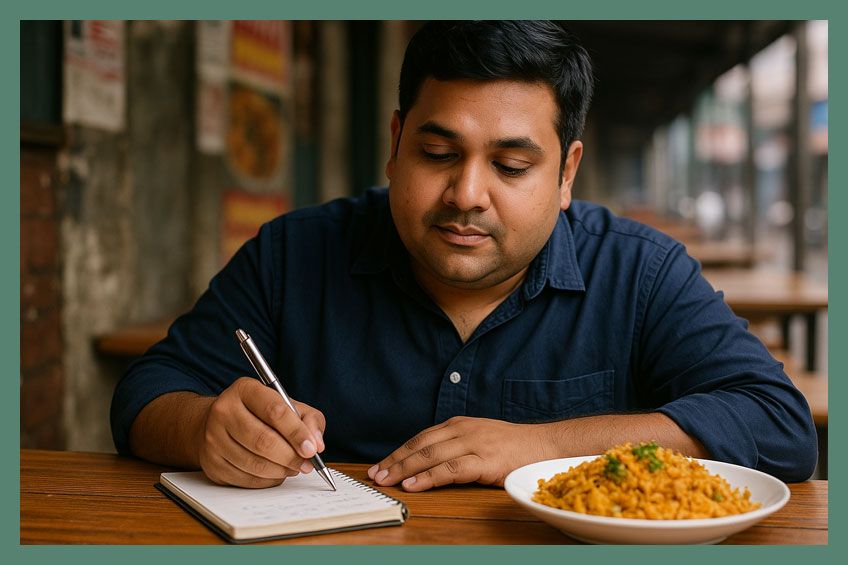
I helped an Indian street food influencer switch voice from merely funny to cultural credibility.
He wasn’t a chef. He wasn’t a vendor. He was something rarer … a true street food connoisseur and critic. He had built an enormous following by unearthing hyperlocal dishes, filming cheerful 2-minute videos on roadside gems, and offering quirky takes on regional favourites. His “5-rupee street food hacks” had earned him thousands of followers across platforms.
But the very voice that earned him reach now restricted his rise. He had bigger ambitions … a book deal on regional food systems, a Netflix pitch on travelling Indian kitchens, and a series of curated food heritage walks. But partners didn’t see him as serious. They loved the popularity, but questioned the depth. His tone was too casual, too playful, too rooted in “moment content.” His authority was misunderstood as immaturity.
When I examined his trajectory, I saw that the issue wasn’t his content—it was his container. He had domain knowledge, cultural sensitivity, and years of exploration … but had never framed himself as someone who knew what he knew.
He had always tried to remain “one of the people” … the friendly guy with a mic, never the expert. But street food, like any cultural form, needs archivists, not just influencers. His real value wasn’t just in showing food … it was in safeguarding memory, migration, and meaning.
The breakthrough came when I repositioned him from entertainer to folklorist. We didn’t eliminate his charm … we embedded it in something deeper. He wasn’t just a street food explorer. He was a custodian of flavour and place. His new line became: “I don’t just taste food. I trace it.”
With that, everything changed. He started recording origin stories, connecting dishes to forgotten trades, caste histories, or colonial disruptions. He slowly veered towards becoming India’s most accessible food scholar … not by sounding academic, but by adding intention to intimacy.
I guided him to introduce context into content. We retained his existing formats … short-form video, informal scripting … but paired each with a layer of cultural framing.
We rewrote his bio and pitch decks to reflect depth, not just following. We built a microsite that categorised dishes by region and history. And we quietly seeded a three-month campaign of longform essays that caught the attention of some literary and culinary gatekeepers.
Here are 10 strategic ideas developed (and several executed) to support the new brand direction:
“Flavour Footnotes” Series: Instagram carousels offering 90-second dish origins after each short-form video, adding lasting value to the scroll.
Redesigned Bio & Hook: Shifted platform intros to: “Street food is India’s open-air archive—I just document it.”
Map-Based Food Trails: Created Google Maps of region-specific food walks, each tagged with history, seasonality, and sensory tips.
Longform Blog Essays: Launched a Substack titled Chutney Chronicles, with reflective essays that layered his informal tone into weightier themes.
YouTube Mini-Docs: 4–5 minute deep dives into forgotten dishes, narrated over local footage, with titles like “The Bread That Survived Partition.”
Partnership with Culinary Historians: Featured co-commentary from researchers to build authority through association.
Book Proposal Pitch: Reframed his book idea as a travelogue + food archive, backed by metrics of digital traction and academic endorsements.
Audio Diary Series: Launched voice-note style content: “After the Eat” … reflections he’d record immediately after each shoot.
Newsletter Feature: “From 5 to Forever”: Weekly column featuring a 5-rupee dish and the story of why it still survives.
Offline Flavour Pop-Up: Hosted curated tasting tables at selected lit fests, titled “The Cheapest Dish That Changed My Mind,” blending story, taste, and theatre.
Invited to speak at a major Indian culinary conference on street food as cultural narrative.
Secured a hybrid publishing deal for his book … advance paid.
Doubled Instagram saves and shares (not just likes) due to deeper storytelling layers.
Signed partnership with a regional tourism board to lead food culture content in 5 cities.
CONFIDENTIALITY CAVEAT: This case study represents a confidential engagement. For privacy, specific brand identifiers, campaign names, and project phases have been withheld. It has been shared with permission while preserving client discretion.

“Brand momentum rarely returns through optimisation or activity. It returns through a breakthrough idea that recentres the brand and restores forward movement.”
Shobha Ponnappa
Download the 14-case collection and receive weekly insights on leadership articulation and brand momentum.
Get my free Case Studies Compendium. Leadership clarity sharpened, strategy articulated, and brands set back into motion.
You’ll also get my fortnightly Brand Reframe newsletter. with smart insights, distilled thinking, and focused ideas to help your brand.
Just fill in the form to join. Be part of our circle thriving on brand clarity, good judgement, and several game-changing tips.