
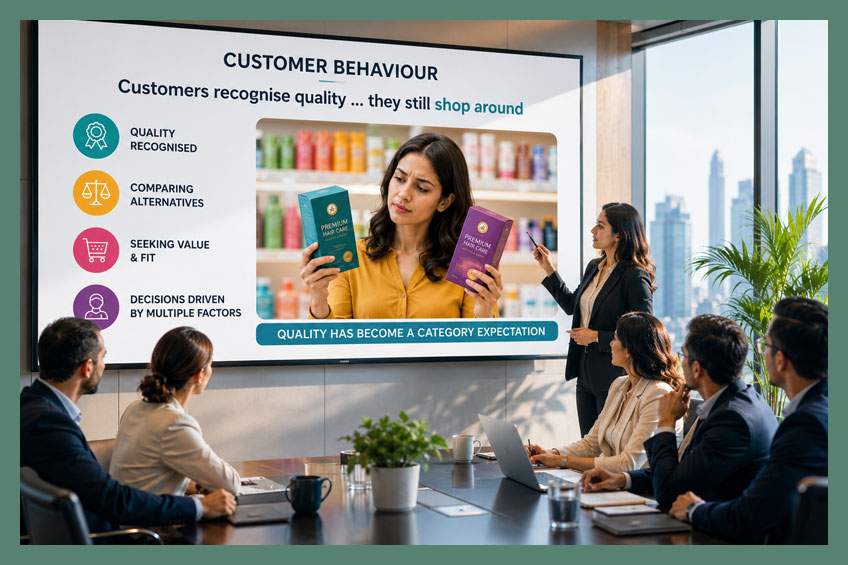
Many businesses become concerned when customers openly acknowledge the superiority of their products or services yet continue evaluating competitors before making a purchase. Teams often assume that recognition of quality should naturally translate into preference, loyalty, or willingness to pay more. Instead, buying behaviour remains fluid, and conversion rates fail to improve despite positive feedback. The visible appreciation for quality may conceal a different basis for choice.
This situation frequently leads organisations to invest further in refining standards, improving processes, and highlighting credentials in their communications. The expectation is that demonstrating even greater excellence will eventually remove hesitation from the buying decision. Yet customers continue behaving as though several alternatives remain equally acceptable. What once differentiated a business may gradually have become an industry expectation.
Customers certainly value quality, particularly when products or services involve meaningful expenditure, risk, or long-term use. However, appreciation and preference are not necessarily the same thing. Buyers often admire several options simultaneously without feeling strongly attached to any one of them. Recognition creates reassurance … preference requires something more distinctive.
As markets mature, certain standards stop feeling exceptional and begin appearing normal. Reliable delivery, competent service, responsive communication, and good workmanship become minimum conditions for participation. Customers may therefore assume quality should already exist before considering other factors. Quality often acts as an entry ticket rather than a deciding factor.
Quality remains essential because poor experiences still discourage repeat purchases and damage reputation. Few organisations can afford to neglect it, and customers continue expecting dependable outcomes. Yet expectations evolve as competitors improve and categories mature over time. Importance does not necessarily guarantee differentiation.
Many industries experience a gradual elevation of standards as technologies improve, suppliers become more capable, and best practices spread widely. Features that once justified premium pricing eventually become assumed by customers. Businesses may therefore continue investing heavily in strengths that no longer influence decisions. Customers rarely reward businesses for merely meeting expected standards.
Executives often believe comparisons should disappear once customers recognise superior capability. In reality, buyers are evaluating an entire proposition rather than judging only technical excellence. Considerations such as convenience, emotional reassurance, familiarity, accessibility, or alignment with personal priorities may shape decisions. People frequently purchase what feels most suitable rather than what appears objectively best.
Competitors do not always need to outperform a market leader on every dimension. They may simply reduce uncertainty, simplify choice, or communicate their value more clearly. Customers comparing several acceptable options may seek reasons to eliminate complexity rather than maximise quality. A buying decision often reflects comfort as much as capability.
The challenge may not lie in communication quality itself, but in the assumptions supporting it. Organisations sometimes continue emphasising credentials, awards, processes, and years of experience because those signals once carried significant weight. Customers may acknowledge these strengths while mentally placing them in the category of expected attributes. Messages lose persuasive power when they describe what buyers already assume exists.
This does not mean organisations should stop discussing competence or reliability altogether. Rather, they may need to explore whether customers are using entirely different criteria to distinguish among providers. The issue is less about proving excellence and more about understanding what genuinely influences preference. Differentiation often emerges from meaning rather than performance alone.
Progress often begins when leaders stop asking how to demonstrate more quality and start examining what customers are actually trying to accomplish. Buying decisions frequently involve emotional, practical, and contextual considerations that sit beyond product performance. Understanding these motivations can reveal opportunities competitors have overlooked. The question shifts from proving superiority to creating stronger relevance.
Once organisations recognise that quality is already assumed, discussions become less defensive and more exploratory. Teams begin investigating what customers value after expectations have already been satisfied. New possibilities emerge around positioning, interpretation, experience, and identity. Momentum returns when businesses compete on meaning instead of standards alone.
Situations like this rarely improve simply by increasing effort in areas where capability is already evident. Organisations often continue polishing strengths that customers have long since taken for granted. As a result, marketing messages become louder while buying behaviour remains largely unchanged. Growth may depend less on improving quality and more on redefining significance.
I take up work for leaders and brands through a focused 5-Day Assignment designed to create movement quickly and precisely. The process begins with a private strategy call, continues through five days of independent analysis, and concludes with a second private strategy call focused on what needs to change. The objective is not to add more activity, but to uncover what may be preventing progress from occurring. The assignment is designed for situations that should be moving, but aren’t.

“I take up work for leaders and brands through a 5-Day Assignment designed to create movement quickly and precisely. How I work is outlined here.”
Shobha Ponnappa
Download The Momentum Diagnostic and receive weekly insights on leadership clarity, brand distinction, and direction.
Get my free Momentum Diagnostic. Discover 12 signals that may be weakening leadership or brand performance.
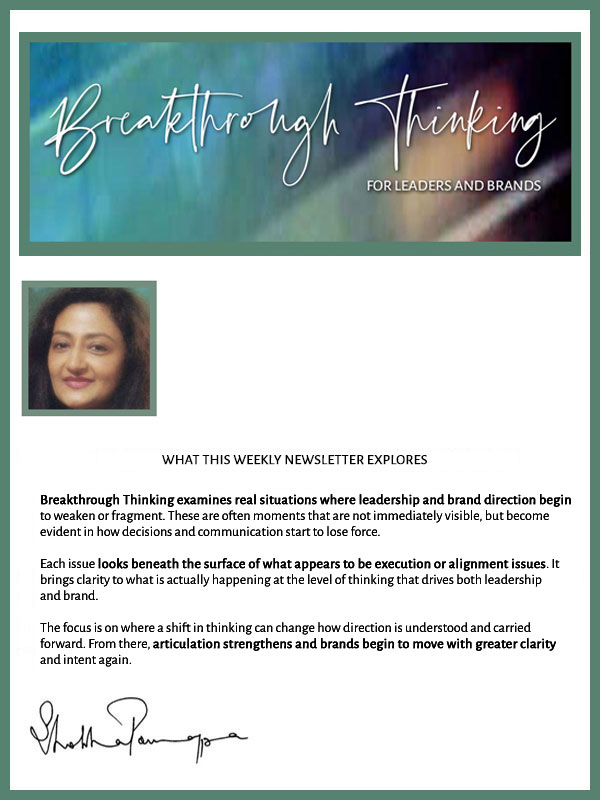
You’ll also get my weekly Breakthrough Thinking newsletter, where I examine real situations across leadership and brands, and defining shifts.
Just fill in the form to subscribe. Stay connected to how this thinking continues to evolve and unfold over time and across situations.