
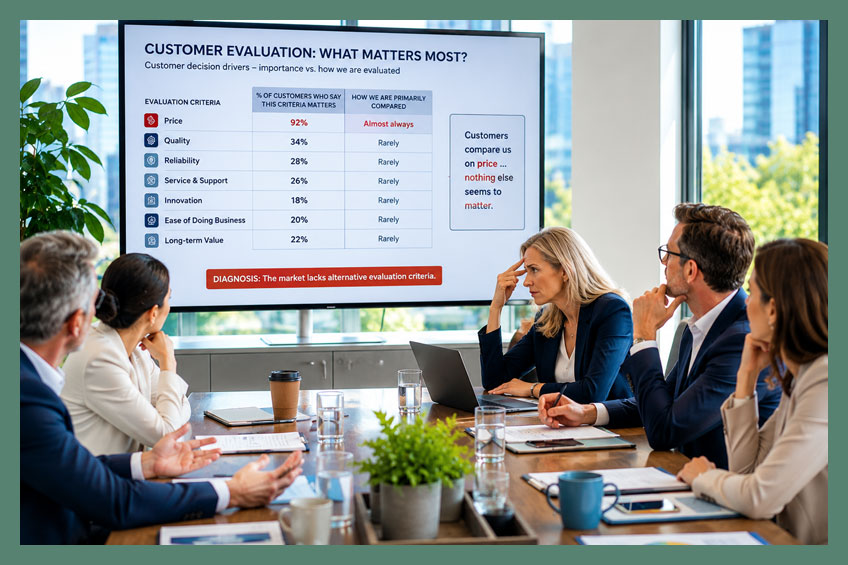
Many leadership teams become frustrated when customers appear to focus almost exclusively on price during purchasing decisions. Significant investments may have been made in quality, service, innovation, customer experience, or expertise, yet these strengths seem to receive little attention during evaluation. Conversations repeatedly return to cost regardless of how the offer is presented. The market appears to be reducing a complex decision to a simple price comparison.
This situation often creates the impression that customers have become increasingly price sensitive. Organisations respond by introducing discounts, adjusting pricing models, or searching for ways to become more competitive on cost. Yet these actions frequently produce only temporary relief before the same pattern reappears. The visible problem may be pricing while the deeper issue lies elsewhere.
Price often becomes dominant when buyers struggle to identify other meaningful differences between available options. When competing offers appear broadly similar, cost provides the easiest and most visible basis for comparison. Customers naturally gravitate towards criteria that feel clear and measurable. Price becomes powerful when alternative criteria are weak.
This does not necessarily mean customers care only about price. In many situations, they simply lack a more compelling framework for evaluating value. Without that framework, price becomes the default decision-making shortcut. Markets compare what they can easily see.
Many organisations assume customers already understand the factors that make their offer different. Internal teams are deeply familiar with their capabilities, expertise, and strengths, making those distinctions appear obvious. Customers, however, may not experience those differences in the same way. What feels distinctive internally may feel interchangeable externally.
When meaningful distinctions remain unclear, comparison becomes compressed into a smaller set of visible factors. Price, delivery speed, and basic specifications often dominate because they are easier to compare than expertise, outcomes, or strategic value. The market therefore simplifies what the organisation considers a complex choice. Undifferentiated offers invite simplified evaluation.
Not necessarily. Many respected organisations experience this challenge despite possessing genuine strengths and capabilities. The issue is often not the absence of differentiation but the absence of recognised differentiation within the market. Valuable distinctions may exist without influencing decision-making. A brand can be distinctive without being perceived as distinctive.
True commoditisation occurs when buyers see little meaningful difference between alternatives. However, many organisations discover that customers simply lack a framework for recognising those differences. The distinction may therefore be strategic rather than operational. Perception frequently determines competitive reality.
Organisations often evaluate themselves through the lens of expertise, effort, investment, and capability. Customers evaluate through the lens of relevance, outcomes, and decision confidence. These perspectives may overlap, but they are rarely identical. Customers value what helps them make choices.
As a result, organisations sometimes communicate strengths that customers acknowledge without using them as buying criteria. Features may be admired, capabilities may be respected, and achievements may be recognised. Yet none of these factors influence final selection if they do not shape evaluation. Recognition does not automatically create preference.
The breakthrough often begins when organisations stop focusing exclusively on defending their price position. Instead, attention shifts towards understanding how customers are making decisions in the first place. This changes the conversation from pricing to evaluation. The objective becomes reshaping criteria rather than winning comparisons.
Once meaningful evaluation criteria become visible, the competitive landscape often changes. Customers begin considering factors they previously overlooked, and discussions expand beyond cost alone. The organisation gains more opportunities to compete on value, relevance, and outcomes. Price loses influence when better criteria emerge.
If customers consistently reduce conversations to price, the issue may not be pricing itself. It may be that the market lacks sufficient reasons to evaluate alternatives differently. In these situations, lowering prices often addresses symptoms while leaving the underlying pattern unchanged. The real challenge may be how value is being judged.
I take up work for leaders and brands through a focused 5-Day Assignment designed to create movement quickly and precisely. The process begins with a private strategy call, continues through five days of independent analysis, and concludes with a second private strategy call focused on what needs to change. The objective is not to add more activity, but to uncover what may be preventing progress from occurring. The assignment is designed for situations that should be moving, but aren’t.

“I take up work for leaders and brands through a 5-Day Assignment designed to create movement quickly and precisely. How I work is outlined here.”
Shobha Ponnappa
Download The Momentum Diagnostic and receive weekly insights on leadership clarity, brand distinction, and direction.
Get my free Momentum Diagnostic. Discover 12 signals that may be weakening leadership or brand performance.
You’ll also get my weekly Breakthrough Thinking newsletter, where I examine real situations across leadership and brands, and defining shifts.

Just fill in the form to subscribe. Stay connected to how this thinking continues to evolve and unfold over time and across situations.