

A leadership team found itself returning to the board with the same proposal multiple times over an eighteen-month period. Each presentation was carefully prepared, supported by extensive analysis, and accompanied by detailed financial projections. The discussions were constructive, yet approval continued to be deferred from one meeting to the next. The organisation appeared to be making progress without reaching a decision.
The delays gradually became more expensive than anyone anticipated. Strategic initiatives remained on hold, resources sat in limbo, and competitors continued moving ahead while internal discussions repeated familiar themes. Board members remained engaged throughout the process and rarely expressed outright opposition to the proposal itself. The absence of disagreement was disguising the absence of alignment.
Most participants believed the problem lay in the quality of the proposal. Additional data was gathered, external benchmarks were commissioned, and increasingly detailed business cases were prepared in response to board concerns. Each round of refinement was expected to provide the confidence needed for approval. The assumption was that more evidence would eventually remove hesitation.
This interpretation seemed reasonable because the board consistently asked for further information. New questions emerged after each discussion, creating the impression that critical facts were still missing. Management teams therefore focused heavily on improving the strength and depth of their supporting materials. The conversation centred on evidence rather than decision-making.
As discussions continued, a different pattern began to emerge. The board was not struggling to understand the proposal, nor was it questioning the quality of the supporting analysis. Instead, individual directors appeared to be evaluating entirely different concerns beneath the surface conversation. The debate was occurring around the proposal rather than about it.
Some directors were focused on financial risk, others on timing, and others on organisational readiness. These concerns were legitimate, but they were being discussed as though they belonged to the same decision. In reality, multiple strategic questions had become tangled together inside a single conversation. The board was debating the wrong question.
Several signals pointed towards this deeper issue. Directors often agreed with individual points being made during meetings, yet discussions repeatedly drifted into unrelated areas before any conclusion could be reached. The same themes resurfaced meeting after meeting despite extensive attempts to resolve them. Consensus existed on details while disagreement remained hidden elsewhere.
Another clue emerged from the language being used around the table. Participants frequently answered questions that had not actually been asked, while others responded to concerns that belonged to different strategic priorities. The conversation appeared productive, yet decisions remained elusive. People were discussing different decisions under the same agenda item.
The breakthrough came when the discussion stopped focusing on whether the proposal should be approved. Instead, attention shifted towards identifying the precise decision the board was actually trying to make. This reframing separated questions of timing, risk, investment, capability, and strategic intent into distinct conversations. Clarity emerged when one decision became several clearly defined decisions.
Once these questions were disentangled, progress accelerated quickly. Directors found it easier to express their concerns, management gained greater visibility into the real barriers, and discussions became significantly more focused. Approval no longer depended on solving every issue simultaneously. The conversation changed because the question changed.
Many leadership teams assume that stalled approvals signal insufficient evidence or weak proposals. While that can occasionally be true, prolonged delays often indicate a different challenge altogether. Decision-makers may be evaluating fundamentally different issues without realising it. The visible debate is not always the real debate.
When approvals repeatedly slip despite extensive preparation, the most useful question may not be whether enough information exists. The more useful question may be whether everyone is trying to answer the same strategic question. Progress becomes difficult when different decisions are bundled together. Alignment begins with defining the decision itself.
If important decisions continue to be deferred despite repeated discussions, additional analysis may not be the solution. The issue may lie in the framing of the conversation rather than the quality of the proposal. Before generating more information, it can be useful to examine what decision is actually being debated. Many stalled approvals are symptoms of unclear decision architecture.
I take up work for leaders and brands through a focused 5-Day Assignment designed to create movement quickly and precisely. The process begins with a private strategy call, continues through five days of independent analysis, and concludes with a second private strategy call focused on what needs to change. The objective is not to generate more activity, but to uncover what may be preventing progress from occurring. The assignment is designed for situations that should be moving, but aren’t.

“I take up work for leaders and brands through a 5-Day Assignment designed to create movement quickly and precisely. How I work is outlined here.”
Shobha Ponnappa
Download The Momentum Diagnostic and receive weekly insights on leadership clarity, brand distinction, and direction.
Get my free Momentum Diagnostic. Discover 12 signals that may be weakening leadership or brand performance.
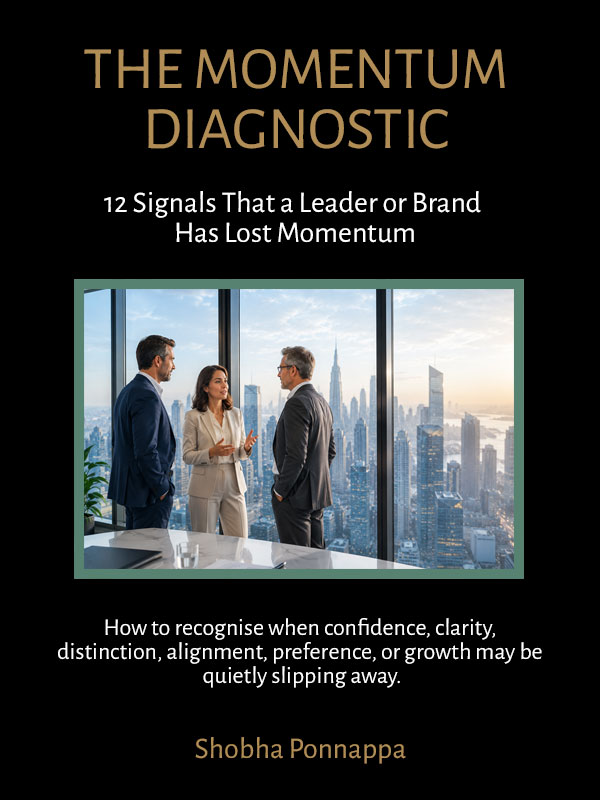
You’ll also get my weekly Breakthrough Thinking newsletter, where I examine real situations across leadership and brands, and defining shifts.
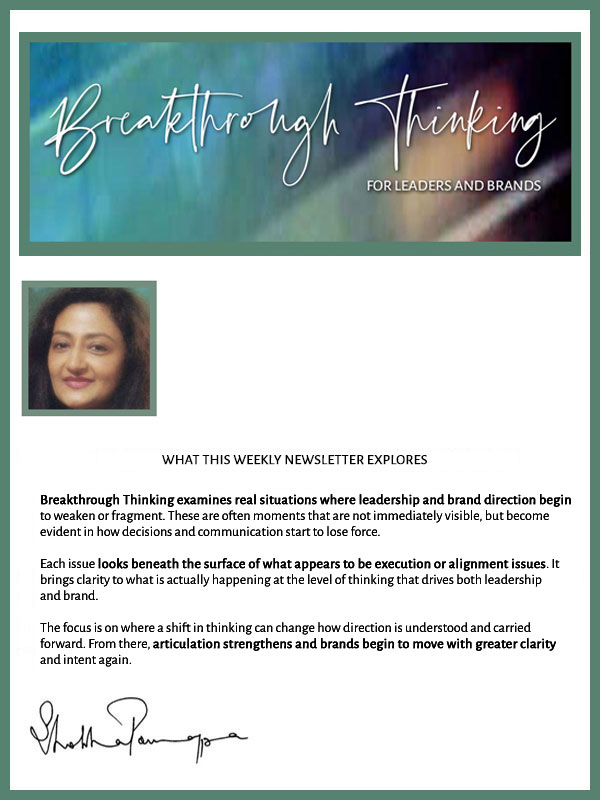
Just fill in the form to subscribe. Stay connected to how this thinking continues to evolve and unfold over time and across situations.