

A leadership team found itself returning to the board with increasingly detailed analyses, forecasts, and supporting materials. Every major recommendation was accompanied by extensive documentation, market data, and financial modelling. The expectation was that stronger evidence would naturally increase confidence and accelerate decision-making. Instead, each presentation generated another request for proof.
The pattern persisted over multiple board cycles. Questions were answered thoroughly, additional scenarios were explored, and external validation was incorporated wherever possible. Yet decisions continued to move slowly, and strategic initiatives remained trapped in discussion rather than execution. The situation suggested that something deeper was influencing the conversation.
Most participants believed the challenge was straightforward. The prevailing assumption was that the board required greater certainty before committing to a significant course of action. If more evidence could be assembled, approval would eventually follow. The focus therefore remained on strengthening the business case.
This interpretation appeared reasonable because boards are expected to exercise caution. Scrutiny, challenge, and rigorous questioning form part of responsible governance. As a result, every request for clarification was treated as a request for more information. Few people considered whether the evidence itself might not be the central issue.
A different pattern began to emerge as the discussions were examined more closely. Board members rarely challenged the quality of the evidence being presented. In many cases, they accepted the facts, the forecasts, and even the strategic rationale. Yet a sense of hesitation continued to surface throughout the dialogue. Agreement was present, but conviction was not.
This distinction proved important. The board was not struggling to understand the recommendation. Nor was it disputing the underlying data. Instead, the evidence was failing to create a sufficiently clear picture of what the organisation needed to do next. The board understood the evidence without fully understanding its implications.
Several signals pointed towards this underlying dynamic. Questions repeatedly returned to issues of organisational readiness, leadership alignment, execution risk, and long-term consequences. The discussion often moved beyond the evidence itself and towards what the evidence meant for future decisions. The real debate was centred on interpretation rather than information.
Further signals appeared in the language being used. Board members frequently asked variations of the same question despite receiving comprehensive answers. The repetition suggested that information gaps were not driving concern. What appeared to be missing was a shared understanding of the strategic significance of the evidence already available.
The breakthrough came when the conversation stopped focusing on evidence accumulation and began focusing on strategic meaning. Rather than presenting additional data, the discussion shifted towards explaining what the evidence revealed about the organisation’s future choices. This altered the nature of the dialogue almost immediately. The focus moved from proof to implication.
Once this shift occurred, previously hidden concerns became easier to address. The board began discussing assumptions openly rather than requesting more validation indirectly. Areas of uncertainty could be acknowledged without creating paralysis. The board stopped asking what the data said and started discussing what it meant.
Many organisations encounter similar situations during periods of strategic change. When progress slows, the instinct is often to gather more information and build a larger evidence base. While analysis is essential, there comes a point where additional proof contributes very little new insight. More data does not always create more certainty.
Leaders benefit from recognising when a discussion has moved beyond evidence. At that stage, the challenge may involve strategic interpretation rather than information quality. Facts can describe a situation accurately while still failing to create a compelling understanding of what should happen next. Strategic progress often depends on articulating meaning rather than accumulating evidence.
If your board continues requesting more evidence despite receiving comprehensive analysis, the obstacle may not be informational. It may be that the strategic implications have not yet been articulated clearly enough to create conviction. In situations like this, producing additional reports often generates diminishing returns. The breakthrough may begin by changing the conversation itself.
I take up work for leaders and brands through a focused 5-Day Assignment designed to create movement quickly and precisely. The process begins with a private strategy call, continues through five days of independent analysis, and concludes with a second private strategy call focused on what needs to change. The objective is not to generate more activity, but to uncover what may be preventing progress from occurring. The assignment is designed for situations that should be moving, but aren’t.

“I take up work for leaders and brands through a 5-Day Assignment designed to create movement quickly and precisely. How I work is outlined here.”
Shobha Ponnappa
Download The Momentum Diagnostic and receive weekly insights on leadership clarity, brand distinction, and direction.
Get my free Momentum Diagnostic. Discover 12 signals that may be weakening leadership or brand performance.
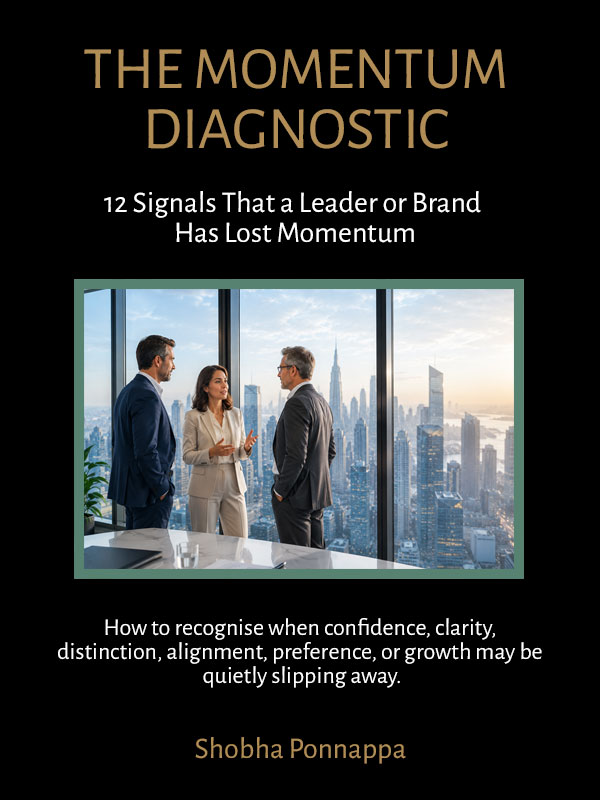
You’ll also get my weekly Breakthrough Thinking newsletter, where I examine real situations across leadership and brands, and defining shifts.
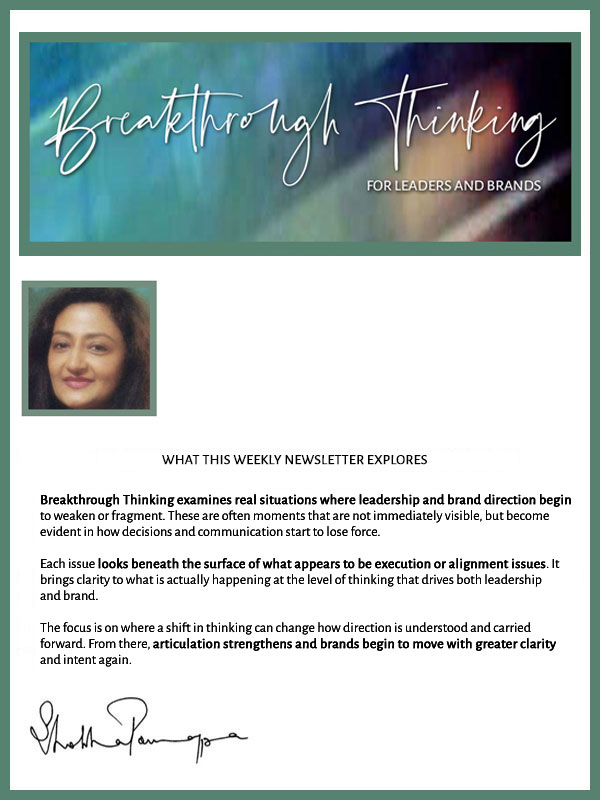
Just fill in the form to subscribe. Stay connected to how this thinking continues to evolve and unfold over time and across situations.