

A leadership team was facing an increasingly frustrating contradiction. Customer surveys were positive, brand sentiment scores were healthy, and feedback regularly reflected warmth towards the organisation. Prospects spoke favourably about the company, its people, and its reputation. Yet positive feelings were not translating into proportional sales.
The situation became more confusing as additional research was gathered. Customers consistently described the brand as trustworthy, capable, and well regarded within its category. Internal teams interpreted these signals as evidence that growth should naturally follow. Instead, customers continued making purchase decisions elsewhere.
Most stakeholders believed the issue was simply one of timing. The assumption was that customers who liked the brand would eventually convert once budgets aligned, priorities shifted, or circumstances improved. Patience appeared to be the most sensible response. The prevailing belief was that preference already existed.
This interpretation felt reasonable because positive customer feedback was abundant. Marketing teams highlighted favourable comments, strong engagement metrics, and encouraging research findings. Senior leaders saw little evidence of dissatisfaction or resistance. The assumption was that affection and purchase intent were largely the same thing.
A different pattern began to emerge when customer behaviour was examined more closely. People genuinely liked the brand, but their final decisions were being shaped by factors that existed outside the brand relationship itself. The moment of purchase involved different pressures, comparisons, and criteria. Approval of the brand was not determining the final choice.
This distinction proved significant. Customers were not rejecting the organisation, questioning its credibility, or expressing dissatisfaction. They simply found stronger reasons to choose alternatives when the buying decision actually occurred. Preference was being won elsewhere at the moment of choice.
Several signals pointed towards this deeper diagnosis. Customers often spoke positively about the brand while simultaneously praising competitors for convenience, relevance, availability, speed, or perceived value. The language of appreciation was present, but the language of commitment was often absent. The emotional relationship was stronger than the commercial advantage.
Market behaviour reinforced the same conclusion. Customers frequently shortlisted the brand, recommended it to others, or interacted with its content, yet still selected different providers when transactions occurred. Nothing suggested hostility towards the organisation. The decisive factors were operating outside the areas where the brand was strongest.
The breakthrough came when the discussion moved beyond customer sentiment. Instead of measuring how much customers liked the brand, attention shifted towards understanding what actually influenced decisions at the point of purchase. This reframed both the diagnosis and the strategic priorities. The focus moved from affection to decision dynamics.
Once this shift occurred, the organisation began mapping the real forces shaping customer choice. Competitive advantages, buying triggers, switching barriers, and evaluation criteria received greater scrutiny. Strategic effort became concentrated on the moment where revenue was actually won or lost. The organisation stopped measuring goodwill and started examining choice.
Many organisations mistake positive sentiment for genuine competitive strength. Customer approval can create confidence that demand is stronger than it really is. This often leads leaders to underestimate the influence of competitors during the buying process. Being liked and being chosen are fundamentally different outcomes.
The market rarely rewards brands simply because customers feel positively towards them. Purchase decisions are usually shaped by a complex combination of relevance, urgency, differentiation, convenience, and perceived value. Strong sentiment helps, but it is rarely sufficient on its own. Choice belongs to the brand that best aligns with decision criteria.
If customers speak highly of your brand yet continue buying elsewhere, the problem may not be awareness, trust, or reputation. The more useful question is what factors become dominant when customers reach the point of decision. In many cases, competitors are winning that moment despite losing the relationship narrative. Understanding choice often reveals more than understanding sentiment.
I take up work for leaders and brands through a focused 5-Day Assignment designed to create movement quickly and precisely. The process begins with a private strategy call, continues through five days of independent analysis, and concludes with a second private strategy call focused on what needs to change. The objective is not to generate more activity, but to uncover what may be preventing progress from occurring. The assignment is designed for situations where customer goodwill exists, but commercial momentum remains elusive.

“I take up work for leaders and brands through a 5-Day Assignment designed to create movement quickly and precisely. How I work is outlined here.”
Shobha Ponnappa
Download The Momentum Diagnostic and receive weekly insights on leadership clarity, brand distinction, and direction.
Get my free Momentum Diagnostic. Discover 12 signals that may be weakening leadership or brand performance.
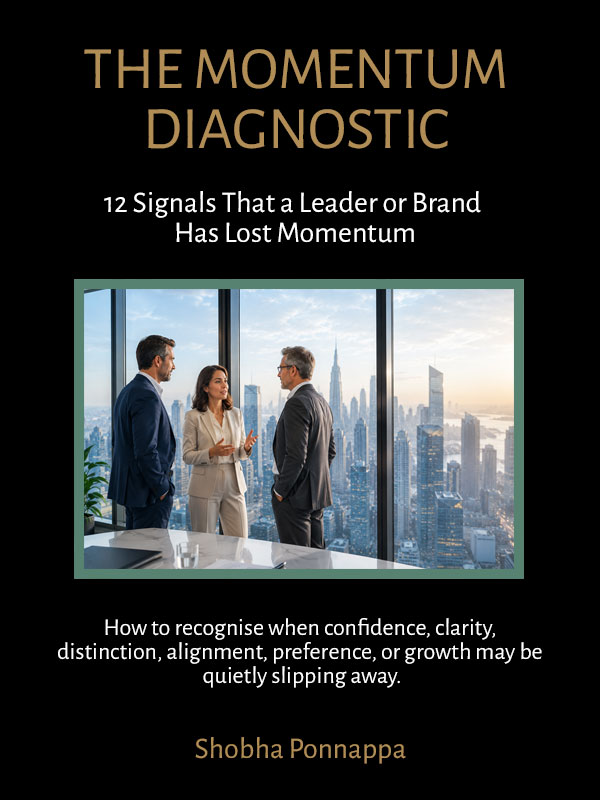
You’ll also get my weekly Breakthrough Thinking newsletter, where I examine real situations across leadership and brands, and defining shifts.
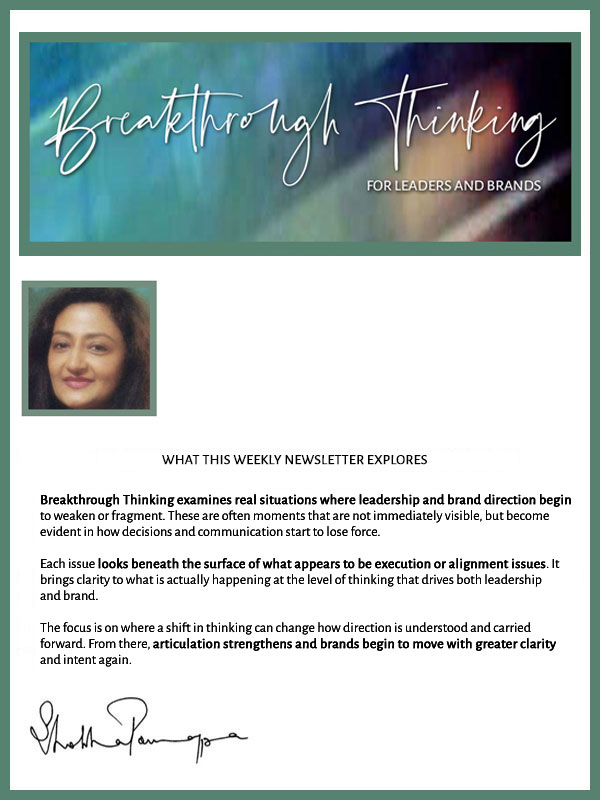
Just fill in the form to subscribe. Stay connected to how this thinking continues to evolve and unfold over time and across situations.