

A well-established organisation had spent years building credibility within its category. Customer research consistently revealed positive perceptions, strong awareness, and widespread recognition of the brand’s expertise. Industry stakeholders frequently cited the company as a trusted and dependable player. The brand had earned respect throughout the market.
Despite these favourable perceptions, growth remained inconsistent. Customers often spoke positively about the organisation while continuing to purchase from competitors with surprising regularity. Market share gains proved difficult to sustain, and customer loyalty remained weaker than expected. Respect was present, but preference remained elusive.
Most stakeholders believed the challenge was one of visibility and reinforcement. The prevailing view was that customers needed more reminders of the brand’s strengths and achievements. Additional campaigns were expected to convert admiration into stronger commercial outcomes. The assumption was that respect naturally leads to preference.
This belief appeared logical because respected brands often enjoy significant advantages. Strong reputations can reduce risk perceptions, improve trust, and strengthen credibility in competitive markets. The organisation therefore focused heavily on amplifying proof points and reinforcing expertise. The strategy concentrated on deepening respect rather than examining choice.
As the situation was examined more closely, a different pattern began to emerge. Customers genuinely respected the organisation, but they rarely expressed strong emotional attachment towards it. The brand was seen as competent, reliable, and trustworthy, yet it occupied little emotional space in customer decision-making. Admiration had not evolved into desire.
This distinction proved critical. People often choose brands for reasons that extend beyond logic, capability, or reputation alone. While respect reduces barriers to consideration, it does not automatically create affinity, attachment, or preference. Respect had not translated into emotional preference.
Several signals pointed towards this deeper issue. Customer interviews frequently contained language associated with trust and competence, but far less language associated with excitement, connection, or identification. People appreciated the brand without feeling personally drawn towards it. The relationship was professional rather than emotional.
Market behaviour reinforced the same conclusion. Customers regularly included the brand on shortlists, recommended it to others, and acknowledged its strengths. Yet when final decisions were made, many selected alternatives that felt more relevant, distinctive, or personally meaningful. The brand was respected more often than it was chosen.
The breakthrough came when the conversation shifted away from credibility and towards emotional meaning. Instead of asking how the organisation could further strengthen its reputation, attention moved towards understanding how customers experienced the brand emotionally. This reframed the strategic challenge entirely. The focus moved from trust to attachment.
Once this shift occurred, new opportunities became visible. The organisation began exploring the emotional territory it could uniquely occupy, the aspirations it could support, and the experiences that could strengthen customer connection. Strategic energy moved beyond proving capability towards creating relevance. Preference became a relationship challenge rather than a reputation challenge.
Many brands encounter this pattern without recognising it. Positive perceptions can create the impression that customer preference should naturally follow, leading organisations to invest heavily in credibility-building activities. Over time, they strengthen respect while overlooking emotional engagement. Customers often admire brands they do not choose.
The more useful question is not whether people respect the brand. The more useful question is whether that respect creates a feeling strong enough to influence behaviour. Preference emerges when rational confidence is combined with emotional connection. Choice is rarely driven by logic alone.
If customers consistently speak well of your organisation yet continue selecting alternatives, the issue may not be credibility. It may be that the emotional dimension of preference has not been sufficiently developed. Additional proof points may therefore produce diminishing returns. The breakthrough often begins when emotional preference is examined directly.
I take up work for leaders and brands through a focused 5-Day Assignment designed to create movement quickly and precisely. The process begins with a private strategy call, continues through five days of independent analysis, and concludes with a second private strategy call focused on what needs to change. The objective is not to generate more activity, but to uncover what may be preventing progress from occurring. The assignment is designed for situations that should be moving, but aren’t.

“I take up work for leaders and brands through a 5-Day Assignment designed to create movement quickly and precisely. How I work is outlined here.”
Shobha Ponnappa
Download The Momentum Diagnostic and receive weekly insights on leadership clarity, brand distinction, and direction.
Get my free Momentum Diagnostic. Discover 12 signals that may be weakening leadership or brand performance.
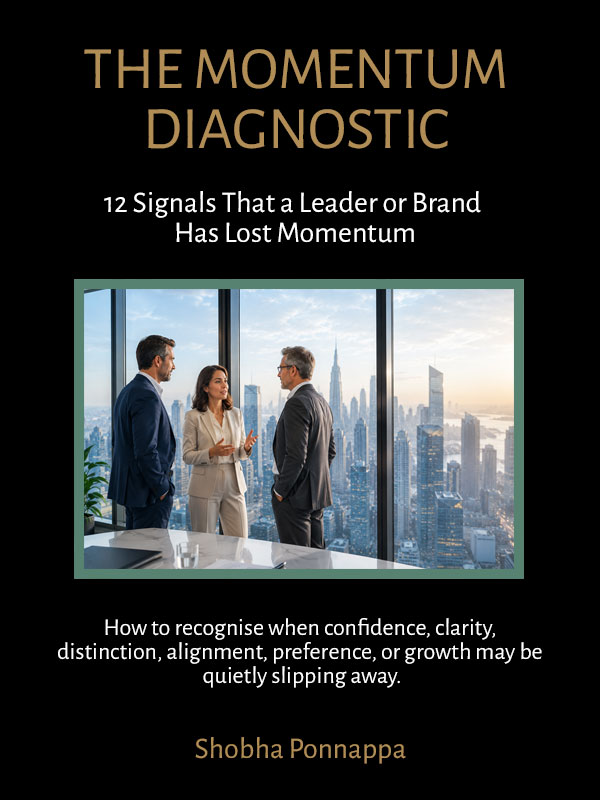
You’ll also get my weekly Breakthrough Thinking newsletter, where I examine real situations across leadership and brands, and defining shifts.
Just fill in the form to subscribe. Stay connected to how this thinking continues to evolve and unfold over time and across situations.