


Many organisations invest significant time explaining why change is necessary before launching a new strategy, transformation programme, or cultural initiative. Leadership presentations become clearer, communication becomes more frequent, and employees receive increasing amounts of information intended to build understanding. Yet despite these efforts, fresh forms of hesitation often continue appearing across the organisation. Explanation alone rarely creates commitment.
Leadership teams are often surprised when people who appear supportive during meetings behave differently once implementation begins. The language of agreement may exist on the surface while uncertainty quietly shapes decisions underneath. Progress slows not because employees reject change outright, but because different groups interpret its meaning in different ways. Resistance often evolves as understanding fragments.
In many situations like this, the organisation assumes that resistance is simply a knowledge problem. Leaders focus on providing additional presentations, FAQs, workshops, and updates in the belief that more information will naturally reduce hesitation. Yet people rarely respond only to the facts they receive. People act according to the meaning they construct.
Sometimes the challenge lies beneath the communication itself. Different departments may translate the same strategic message through the lens of their own priorities, pressures, and incentives until several versions of the intended change begin circulating simultaneously. Each interpretation feels reasonable from within its own context, even while pulling the organisation in different directions. Change begins drifting long before execution becomes visible.
You may notice it when leadership keeps refining presentations while implementation produces inconsistent behaviour across teams. Projects appear to begin enthusiastically, yet momentum repeatedly fades as local interpretations gradually replace the original strategic intention. Meetings become increasingly focused on clarification rather than coordinated progress. The organisation keeps explaining while alignment quietly weakens.
Sometimes the signs emerge through questions that never seem to disappear. Different functions continue asking for clarification despite repeated communication because each group is trying to reconcile the strategy with its own operational reality. The volume of explanation increases while shared interpretation becomes increasingly difficult to sustain. The conversation becomes active even as coherence declines.
When resistance keeps evolving, leaders often respond by increasing communication even further. More town halls, newsletters, videos, and workshops may follow in the hope that repetition will finally remove uncertainty. Yet repetition cannot resolve differences in interpretation if those differences are never addressed directly. Communication cannot substitute for shared meaning.
Over time, this creates a much deeper organisational challenge. Teams continue working hard, initiatives continue moving forward, and activity remains highly visible, yet strategic consistency gradually erodes beneath the surface. The organisation believes it is managing change while quietly accumulating executional divergence. Misalignment compounds long before failure becomes measurable.
This is often where I work … not by producing more communication, but by examining how strategic meaning travels beneath the organisation. The breakthrough often comes from identifying where interpretation begins separating from intention before visible resistance takes hold. Once those invisible points of divergence become clear, execution usually becomes more consistent without increasing communication volume. Shared meaning creates stronger momentum than repeated explanation.
In my work, I often look for the hidden space between what leadership intends and what the organisation gradually understands. Sometimes the strategy itself is entirely sound, yet different layers of interpretation slowly reshape it before it reaches execution. When that invisible translation process is strengthened, resistance often gives way to genuine alignment. The deepest change usually happens beneath the visible organisation.
If this feels familiar, I take this up through a focused 5-Day Assignment … one 40-minute private strategy call to understand the situation, five days of independent work, and a second 40-minute private strategy call to take you through what needs to change.
Request a 5-Day Assignment here: https://shobhaponnappa.com/how-to-work-with-me/
The page outlines how I work, the assignment structure, fee range, and how to submit a brief note on your situation for review. If the fit and timing are right, I will come back to you directly. Not every situation needs this … but the right ones often benefit from a breakthrough early.
SHOBHA PONNAPPA
Breakthrough Strategist for Leaders and Brands in High-Stakes Moments
“One distinctive idea moves a brand. One defining voice moves a market.”

“I take up work for leaders and brands through a 5-Day Assignment designed to create movement quickly and precisely. How I work is outlined here.”
Shobha Ponnappa
Download The Momentum Diagnostic and receive weekly insights on leadership clarity, brand distinction, and direction.
Get my free Momentum Diagnostic. Discover 12 signals that may be weakening leadership or brand performance.
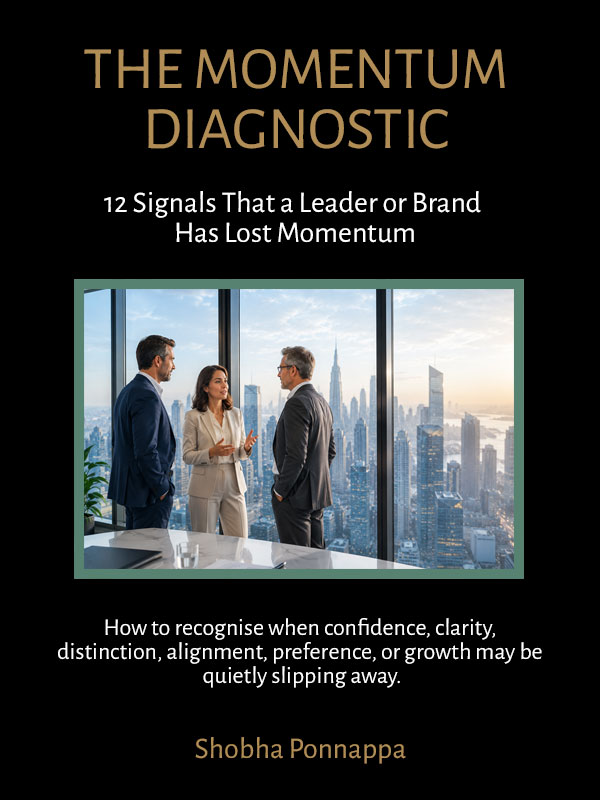
You’ll also get my weekly Breakthrough Thinking newsletter, where I examine real situations across leadership and brands, and defining shifts.
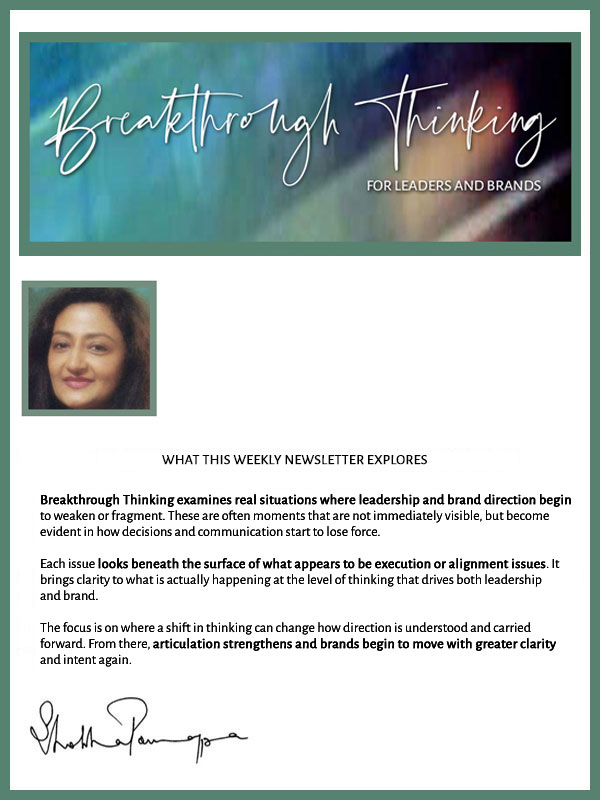
Just fill in the form to subscribe. Stay connected to how this thinking continues to evolve and unfold over time and across situations.