


Many organisations genuinely believe they are improving understanding by supplying ever more information. Presentations become longer, reports become denser, meetings generate additional explanations, and every decision arrives accompanied by more background. Teams rarely complain about a lack of information because there is usually far too much of it. Context expands while attention becomes increasingly fragmented.
This often surprises leadership because the organisation appears highly informed on the surface. Everyone has access to detailed data, extensive documentation, and multiple perspectives, yet priorities become increasingly difficult to sustain across the business. Important work repeatedly competes with interesting work until both begin receiving equal attention. Information grows faster than organisational focus.
In many situations like this, leaders gradually begin equating completeness with clarity. Every discussion accumulates additional qualifications, historical references, stakeholder considerations, and supporting material because leaving something out feels risky. Decisions become surrounded by explanation rather than anchored by direction. The desire to include everything slowly obscures what matters most.
Sometimes the problem lies in confusing context with judgement. Context explains the environment surrounding a decision, while judgement determines what deserves attention within that environment. When organisations continually expand explanation without strengthening prioritisation, every issue begins appearing equally significant. Focus disappears whenever importance is no longer distinguished from information.
You may notice it when meetings consistently run over time despite careful preparation. Conversations become increasingly detailed, yet participants leave with different interpretations of the priorities that supposedly emerged. Teams remain busy clarifying rather than progressing. Discussion becomes abundant while decisive movement becomes scarce.
Sometimes the signs appear through execution itself. Projects continue absorbing new requirements, fresh considerations, additional stakeholders, and expanding documentation long after the original objective was understood. Work rarely stalls because people lack intelligence, but because attention keeps being redistributed. Every layer of added context quietly weakens collective concentration.
When organisational focus begins disappearing, leadership often assumes the answer is still more communication. Additional presentations, strategy documents, workshops, and explanatory meetings are introduced to eliminate misunderstanding across the business. Yet each new layer often enlarges the informational landscape without sharpening the strategic centre. More explanation rarely restores clarity once priorities have become diluted.
Over time, this creates a quieter strategic cost that organisations seldom recognise immediately. Decision quality begins declining because people spend increasing energy processing possibilities rather than committing to direction. Execution slows even while activity remains exceptionally high across the business. Businesses rarely lose momentum because they know too little, but because they struggle to protect what deserves sustained attention.
This is often where I work … not by reducing information indiscriminately, but by identifying the organising principle that allows complexity to become coherent again. Most organisations already possess the knowledge they need to move forward, yet that knowledge has become scattered across competing narratives and priorities. Once a clearer organising principle emerges, decisions naturally begin aligning around it. Focus is rarely created by adding less information, but by strengthening the idea that organises it.
In my work, I often examine where strategic attention begins dispersing beneath the visible activity of the organisation. Sometimes every piece of context is individually valid, yet collectively they prevent leaders from recognising the central judgement the business actually requires. Once that judgement becomes explicit, communication usually becomes shorter, execution becomes faster, and alignment becomes easier to sustain. Clarity comes not from explaining everything, but from knowing what deserves to remain central.
If this feels familiar, I take this up through a focused 5-Day Assignment … one 40-minute private strategy call to understand the situation, five days of independent work, and a second 40-minute private strategy call to take you through what needs to change.
Request a 5-Day Assignment here: https://shobhaponnappa.com/how-to-work-with-me/
The page outlines how I work, the assignment structure, fee range, and how to submit a brief note on your situation for review. If the fit and timing are right, I will come back to you directly. Not every situation needs this … but the right ones often benefit from a breakthrough early.
SHOBHA PONNAPPA
Breakthrough Strategist for Leaders and Brands in High-Stakes Moments
“One distinctive idea moves a brand. One defining voice moves a market.”

“I take up work for leaders and brands through a 5-Day Assignment designed to create movement quickly and precisely. How I work is outlined here.”
Shobha Ponnappa
Download The Momentum Diagnostic and receive weekly insights on leadership clarity, brand distinction, and direction.
Get my free Momentum Diagnostic. Discover 12 signals that may be weakening leadership or brand performance.
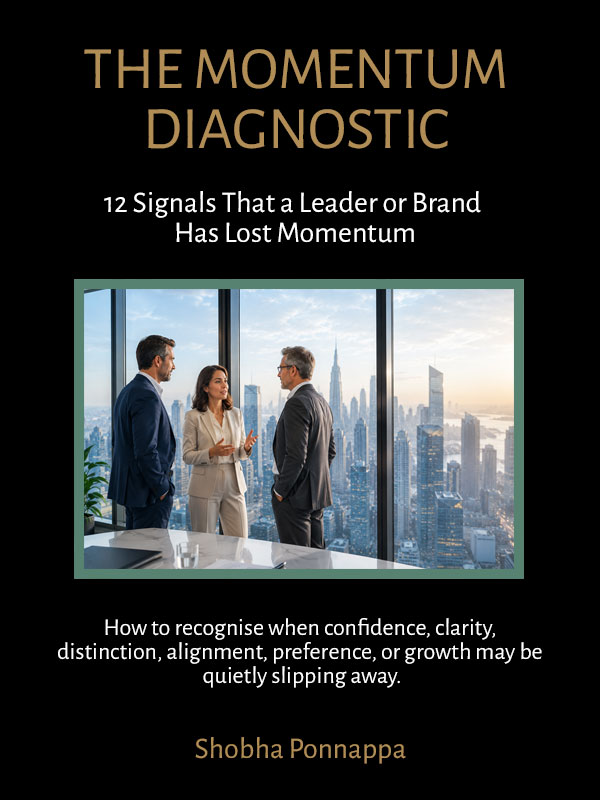
You’ll also get my weekly Breakthrough Thinking newsletter, where I examine real situations across leadership and brands, and defining shifts.
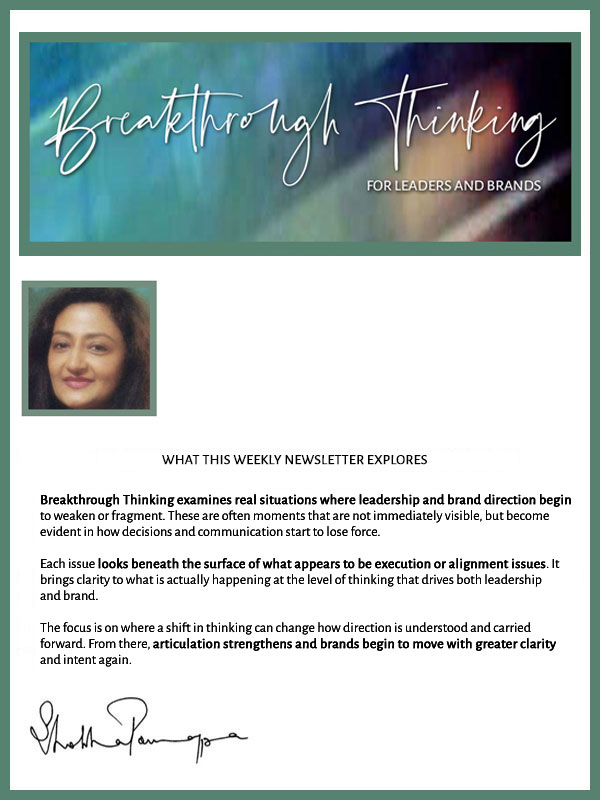
Just fill in the form to subscribe. Stay connected to how this thinking continues to evolve and unfold over time and across situations.