

A company had spent several years addressing deep operational and financial challenges that had threatened its future. Costs were improving, performance indicators were moving in the right direction, and internal confidence was beginning to return. Leadership could point to measurable signs of progress across multiple areas of the business. The turnaround itself appeared increasingly real and measurable.
Yet external stakeholders remained cautious despite the visible improvements. Investor sentiment remained muted, analyst commentary was hesitant, and market valuations showed little enthusiasm for the recovery underway. The organisation felt trapped between improving reality and lingering perception. Progress was visible internally while credibility remained fragile externally.
Most stakeholders believed that time alone would solve the problem. The assumption was that once enough positive results accumulated, confidence would naturally follow. Markets were expected to recognise the evidence and adjust their views accordingly. The prevailing belief was that facts would eventually speak for themselves.
This seemed reasonable because the underlying improvements were genuine. Revenue trends were stabilising, operational metrics were improving, and management execution was becoming more disciplined. From an internal perspective, the recovery story appeared increasingly obvious. The assumption was that evidence automatically creates belief.
As the situation was examined more closely, a different pattern began to emerge. The organisation possessed improving results, but those results existed as isolated proof points rather than a coherent explanation of change. External audiences could see positive developments without fully understanding what they meant. Evidence existed, but meaning had not yet been constructed around it.
Markets rarely respond to data alone. Investors and analysts seek confidence that improvement is sustainable, repeatable, and strategically significant. Individual successes may generate interest, but they do not necessarily create conviction about future performance. Recovery evidence had not yet become a credible narrative.
Several signals pointed towards this deeper issue. Conversations with stakeholders often acknowledged the improvements while immediately qualifying them with uncertainty. Positive developments were treated as temporary events rather than proof of a transformed trajectory. Recognition was present, but conviction remained absent.
A second signal emerged in the language surrounding the business. Commentary focused heavily on historical weaknesses and previous disappointments, even when discussing recent progress. The organisation was still being interpreted through an outdated mental model formed during more difficult years. The market was seeing today’s evidence through yesterday’s story.
The breakthrough came when attention shifted away from proving that progress existed. Instead, the focus moved towards explaining how individual improvements connected to a larger strategic transformation. The discussion evolved from reporting outcomes to demonstrating cause and effect. The priority became narrative credibility rather than evidence accumulation.
This change altered the way leadership communicated with stakeholders. Results were no longer presented as disconnected achievements but as reinforcing elements of a broader recovery story. The organisation began linking operational improvements, strategic decisions, and future opportunities into a coherent explanation of momentum. The turnaround became understandable as a journey rather than a collection of metrics.
Many organisations underestimate the role narrative plays during periods of recovery. Leaders often assume that strong performance will automatically reshape market perceptions. In reality, stakeholders frequently require a framework that helps them interpret what they are seeing. Evidence gains power when it is connected to meaning.
This is particularly true after periods of difficulty. Negative perceptions can remain surprisingly durable even when circumstances improve significantly. Markets often need a compelling explanation before they are willing to revise long-held assumptions. Belief usually changes more slowly than performance.
If your organisation is producing encouraging results while external confidence remains weak, the challenge may not be operational. It may be that stakeholders have not yet been given a sufficiently credible story through which to understand the progress occurring. Additional evidence alone may not resolve that gap. The issue may be interpretation rather than performance.
Many leadership teams focus on creating results without devoting equal attention to shaping understanding. When that happens, recovery can remain undervalued for longer than expected. The objective is not to manufacture perception, but to ensure that genuine progress is interpreted accurately. Markets respond most strongly when evidence and narrative reinforce one another.

“I take up work for leaders and brands through a 5-Day Assignment designed to create movement quickly and precisely. How I work is outlined here.”
Shobha Ponnappa
Download The Momentum Diagnostic and receive weekly insights on leadership clarity, brand distinction, and direction.
Get my free Momentum Diagnostic. Discover 12 signals that may be weakening leadership or brand performance.
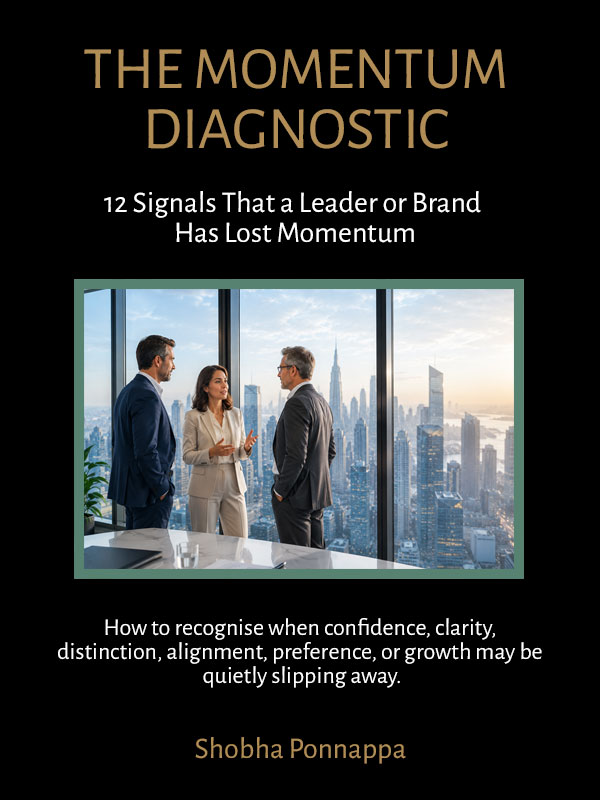
You’ll also get my weekly Breakthrough Thinking newsletter, where I examine real situations across leadership and brands, and defining shifts.

Just fill in the form to subscribe. Stay connected to how this thinking continues to evolve and unfold over time and across situations.