

Many leaders assume that well-structured arguments naturally produce support, alignment, and decisive action. Presentations become sharper, business cases become more rigorous, and recommendations become increasingly evidence-based in the hope of reducing resistance. Yet people do not always commit simply because they understand the rationale behind a decision. Logic may explain a path … but emotion often determines whether people walk it.
This is often why organisations become puzzled when apparently compelling proposals fail to generate energy or ownership. Teams may acknowledge that the analysis is sound, agree that the direction appears sensible, and even express admiration for the quality of the thinking involved. Yet hesitation remains, momentum slows, and enthusiasm quietly fades after the meeting ends. People may accept conclusions intellectually while remaining unconvinced emotionally.
In many situations like this, leaders unintentionally treat decision-making as an exercise in persuasion rather than participation. The focus remains on strengthening arguments, improving presentations, and eliminating objections without recognising that people are often evaluating what a change means for them personally. Concerns about identity, status, familiarity, and control may remain largely unspoken. Human beings rarely commit only because a case has been made.
Sometimes the issue lies in assuming that agreement automatically signals readiness. Teams may nod in support because they respect leadership, appreciate the effort invested, or simply wish to avoid appearing resistant in public settings. Yet genuine commitment often requires individuals to see themselves within the future being proposed. People support what they can emotionally inhabit rather than merely understand.
You may notice it when presentations receive positive feedback, business plans are approved, and strategic priorities appear broadly accepted, yet implementation continues moving far more slowly than expected. Teams may keep asking additional questions, requesting further analysis, or suggesting minor adjustments despite having sufficient information already. The discussion seems complete while the energy feels strangely absent. Conviction may appear visible … while commitment remains surprisingly shallow.
Sometimes the signs emerge through behaviour rather than words. People may continue referencing previous ways of working, delaying important actions, or quietly returning to familiar routines despite publicly supporting the intended direction. Leaders may become frustrated because they cannot identify any obvious disagreement to address. Resistance often survives not through argument … but through emotional detachment.
When emotional commitment remains weak, organisations often respond by increasing the amount of information being shared. More presentations may follow, alongside additional reports, stronger financial projections, and repeated attempts to reinforce the original recommendation. Yet accumulating evidence does not necessarily deepen engagement if underlying concerns remain untouched. People rarely become inspired simply because the spreadsheet improved.
Over time, this creates a more subtle organisational challenge. The business may continue making sensible decisions while gradually weakening its ability to mobilise people behind meaningful change. Teams become skilled at analysing possibilities yet hesitant about embracing them fully. Transformation succeeds less through intellectual agreement … and more through emotional participation.
This is often where I work … not by strengthening the argument itself, but by exploring the emotional landscape surrounding the decision. The breakthrough may come from understanding what people believe they are losing, protecting, preserving, or risking rather than what they think about the proposal intellectually. Once those deeper dynamics become visible, resistance often starts making far more sense. People seldom oppose change itself … they more often protect something important to them.
In my work, I often look for the invisible gap between strategic certainty and human readiness. Sometimes the recommendation is already strong enough, but the conversation has remained focused on proving rather than connecting. Once people begin recognising themselves within the future being described, movement often becomes easier and faster. The objective is not simply to win agreement … but to create genuine commitment.
If this feels familiar, I take this up through a focused 5-Day Assignment … one 40-minute private strategy call to understand the situation, five days of independent work, and a second 40-minute private strategy call to take you through what needs to change.
Request a 5-Day Assignment here: https://shobhaponnappa.com/how-to-work-with-me/
The page outlines how I work, the assignment structure, fee range, and how to submit a brief note on your situation for review. If the fit and timing are right, I will come back to you directly. Not every situation needs this … but the right ones often benefit from a breakthrough early.
SHOBHA PONNAPPA
Breakthrough Strategist for Leaders and Brands in High-Stakes Moments
“One distinctive idea moves a brand. One defining voice moves a market.”

“I take up work for leaders and brands through a 5-Day Assignment designed to create movement quickly and precisely. How I work is outlined here.”
Shobha Ponnappa
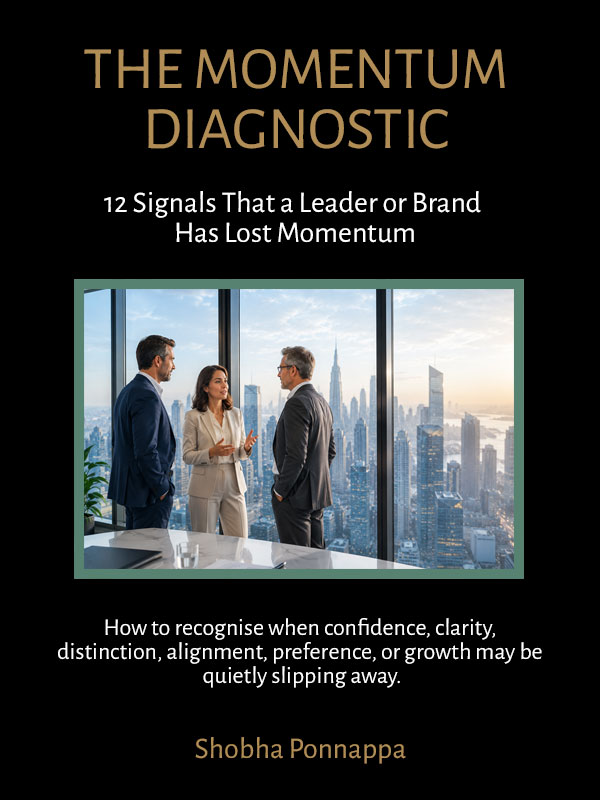
Download The Momentum Diagnostic and receive weekly insights on leadership clarity, brand distinction, and direction.
Get my free Momentum Diagnostic. Discover 12 signals that may be weakening leadership or brand performance.
You’ll also get my weekly Breakthrough Thinking newsletter, where I examine real situations across leadership and brands, and defining shifts.
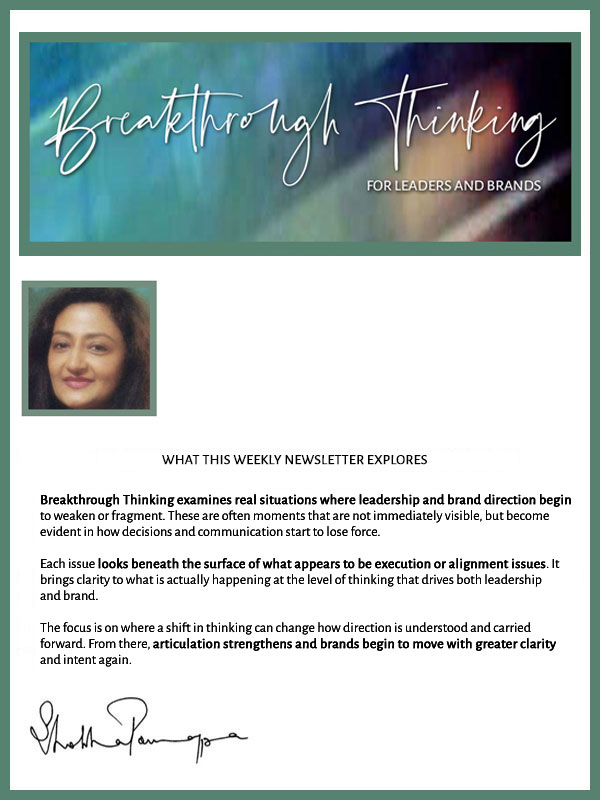
Just fill in the form to subscribe. Stay connected to how this thinking continues to evolve and unfold over time and across situations.