


Many businesses achieve growth by becoming exceptionally good at a particular way of operating. The leadership team develops proven habits, reliable decision-making patterns, successful processes, and familiar strategic assumptions that repeatedly produce positive results. These strengths often become deeply embedded in how the organisation thinks and behaves. What once created momentum gradually becomes the default way of seeing every new challenge.
This is often why companies encounter unexpected resistance when entering a new phase of growth. The market may be changing, customer expectations may be evolving, or the business itself may have become more complex than before. Yet the organisation continues relying on the same strengths that worked so effectively in earlier stages. Past success may remain valuable … but it does not always remain sufficient.
In many situations like this, success creates a powerful form of organisational confidence. Teams naturally trust the approaches that have already delivered growth, profitability, customer loyalty, or market recognition. The business begins reinforcing familiar strengths because they feel proven, dependable, and low risk. What worked repeatedly starts feeling like the safest answer to every future question.
Sometimes the issue lies in the hidden assumptions attached to those strengths. A company that grew through operational efficiency may continue prioritising control when innovation is required. A business built through founder intuition may struggle when broader leadership participation becomes necessary. The strength itself is rarely the problem. The challenge often emerges when yesterday’s advantage becomes today’s limitation.
You may notice it when the organisation continues performing well in familiar situations while struggling to respond effectively to new ones. Teams may work harder, increase activity, and double down on existing capabilities, yet progress begins slowing unexpectedly. Leadership discussions often focus on execution while avoiding deeper questions about direction. The business keeps doing more of what worked … and wonders why results are changing.
Sometimes the signs emerge through recurring strategic frustrations. New initiatives may stall, transformation efforts may move slowly, or talented people may become constrained by established ways of working. Internal conversations frequently return to familiar solutions even when those solutions are producing diminishing returns. The organisation remains highly capable … but increasingly less adaptable.
When growth strengths begin limiting future progress, leaders often interpret the situation as a temporary execution problem. Additional resources may be allocated, performance targets may be increased, and teams may be encouraged to work with greater urgency. Yet none of these actions address the underlying issue if the operating assumptions themselves need to evolve. More effort rarely solves a challenge created by an outdated growth model.
Over time, this can create a widening gap between the business and its future opportunities. Competitors may respond more effectively to changing market conditions because they are not as attached to historical success patterns. Meanwhile, the organisation continues protecting strengths that once created value while unintentionally restricting new possibilities. The very capabilities that built the company may begin slowing its next chapter of growth.
This is often where I work … not by questioning whether the organisation’s strengths are valuable, but by examining whether they still fit the next stage of growth. The breakthrough may come from identifying which strengths should be preserved, which should be expanded, and which may now require rethinking. Growth often stalls not because capability is missing, but because capability is being applied to a different problem than the one it originally solved. The goal is not to abandon strengths … but to evolve them.
In my work, I often look for the invisible tension between historical success and future opportunity. Sometimes the business possesses exactly the capabilities it needs, but those capabilities are being expressed through outdated structures, assumptions, or leadership habits. Once that tension becomes visible, leaders can begin making more deliberate choices about what to carry forward and what to leave behind. The next stage of growth often begins when the organisation stops being managed by its own success.
If this feels familiar, I take this up through a focused 5-Day Assignment … one 40-minute private strategy call to understand the situation, five days of independent work, and a second 40-minute private strategy call to take you through what needs to change.
Request a 5-Day Assignment here: https://shobhaponnappa.com/how-to-work-with-me/
The page outlines how I work, the assignment structure, fee range, and how to submit a brief note on your situation for review. If the fit and timing are right, I will come back to you directly. Not every situation needs this … but the right ones often benefit from a breakthrough early.
SHOBHA PONNAPPA
Breakthrough Strategist for Leaders and Brands in High-Stakes Moments
“One distinctive idea moves a brand. One defining voice moves a market.”

“I take up work for leaders and brands through a 5-Day Assignment designed to create movement quickly and precisely. How I work is outlined here.”
Shobha Ponnappa
Download The Momentum Diagnostic and receive weekly insights on leadership clarity, brand distinction, and direction.
Get my free Momentum Diagnostic. Discover 12 signals that may be weakening leadership or brand performance.
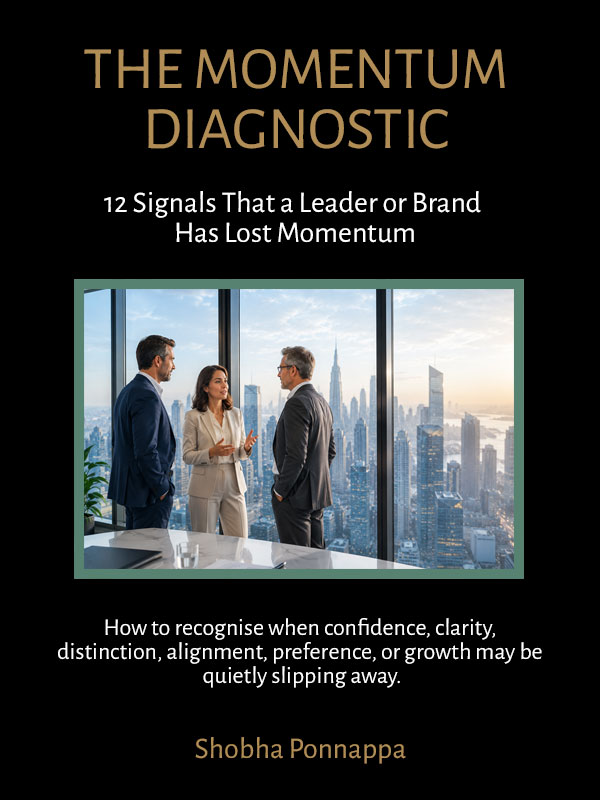
You’ll also get my weekly Breakthrough Thinking newsletter, where I examine real situations across leadership and brands, and defining shifts.
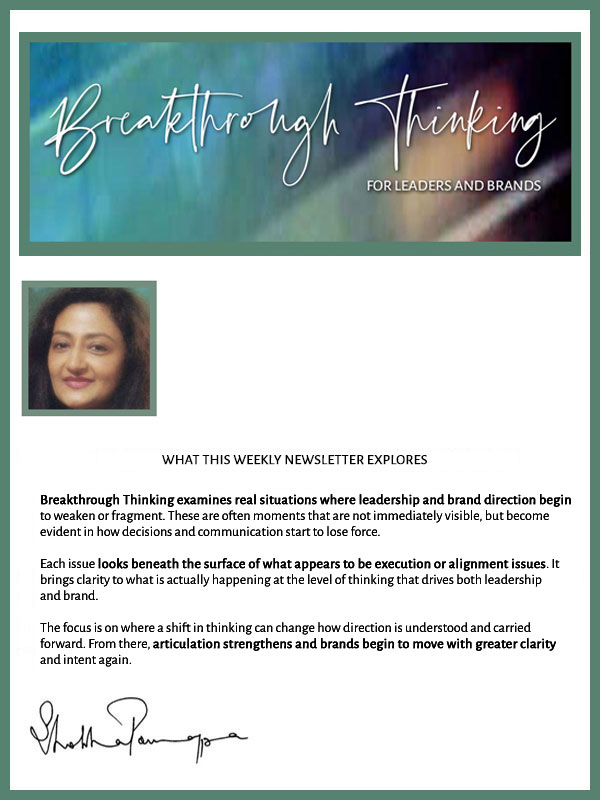
Just fill in the form to subscribe. Stay connected to how this thinking continues to evolve and unfold over time and across situations.