

Leadership teams are often puzzled when a strategy that appears robust, coherent, and commercially compelling continues to encounter hesitation at board level. The analysis may be rigorous, the assumptions may have been tested thoroughly, and the opportunity may appear strategically attractive. Yet confidence remains fragile, and discussions repeatedly return to familiar concerns. The strategy appears understood while conviction remains absent.
This situation frequently creates frustration because leaders assume understanding should naturally lead to support. Additional presentations are prepared, further evidence is gathered, and increasingly detailed forecasts are developed. Despite these efforts, confidence often remains unchanged. The visible discussion may be about the strategy while the real concern lies in its implications.
Many executives assume that understanding and agreement are closely linked. If directors understand the logic, opportunity, and rationale behind a recommendation, support should logically follow. In reality, board decisions involve more than comprehension alone. Understanding explains a strategy while confidence permits commitment.
Boards often evaluate what a strategy could mean rather than simply what it contains. They examine consequences, exposures, organisational readiness, stakeholder reactions, and long-term implications. A strategy can therefore be well understood while remaining difficult to fully endorse. Implications frequently matter more than explanations.
These questions often indicate that the board has moved beyond understanding the recommendation itself. Directors may already accept the logic and rationale being presented. Their attention has shifted towards the potential outcomes that could emerge from implementation. The discussion has moved from strategy to consequence.
This distinction is important because management teams often respond with additional strategic detail. The board, however, may be seeking reassurance about risk, execution, timing, or organisational capability. Questions about implications can sometimes be mistaken for questions about understanding. Boards often probe consequences rather than concepts.
When support remains uncertain, the natural response is usually to strengthen the case. Additional analysis is commissioned, more data is assembled, and increasingly sophisticated arguments are presented. These efforts may improve the recommendation without addressing the actual concern. Evidence cannot resolve a question it was never designed to answer.
In some situations, additional information may even reinforce hesitation. The board receives greater detail about the strategy while remaining uncertain about its practical implications. Discussions become richer in information but not necessarily stronger in confidence. More explanation does not always create more certainty.
The answer varies from one organisation to another, but several themes frequently emerge. Directors may be concerned about execution capability, financial exposure, stakeholder response, timing, market volatility, or unintended consequences. These concerns often exist beneath the visible discussion. The strategy itself may not be the source of uncertainty.
Boards carry responsibilities that extend beyond growth and opportunity. They must also consider resilience, governance, continuity, and risk management. As a result, implications that appear secondary to management may feel central to directors. Different responsibilities create different decision lenses.
The breakthrough often begins when leaders stop focusing exclusively on explaining the strategy. Attention shifts towards understanding which implications are creating uncertainty and why they matter. This changes the nature of the discussion entirely. The conversation moves from advocacy to exploration.
Once the underlying concerns become visible, directors and management teams often find greater common ground. Discussions become less repetitive because participants are examining the same issue rather than different interpretations of it. Confidence develops when implications become clearer. Alignment frequently follows clarity of consequence.
If the board appears to understand your strategy but remains hesitant to support it, the challenge may not be communication. It may be that important implications have not yet been sufficiently explored or addressed. In these situations, stronger presentations often produce diminishing returns. The issue may lie beyond the strategy itself.
I take up work for leaders and brands through a focused 5-Day Assignment designed to create movement quickly and precisely. The process begins with a private strategy call, continues through five days of independent analysis, and concludes with a second private strategy call focused on what needs to change. The objective is not to add more activity, but to uncover what may be preventing progress from occurring. The assignment is designed for situations that should be moving, but aren’t.

“I take up work for leaders and brands through a 5-Day Assignment designed to create movement quickly and precisely. How I work is outlined here.”
Shobha Ponnappa
Download The Momentum Diagnostic and receive weekly insights on leadership clarity, brand distinction, and direction.
Get my free Momentum Diagnostic. Discover 12 signals that may be weakening leadership or brand performance.
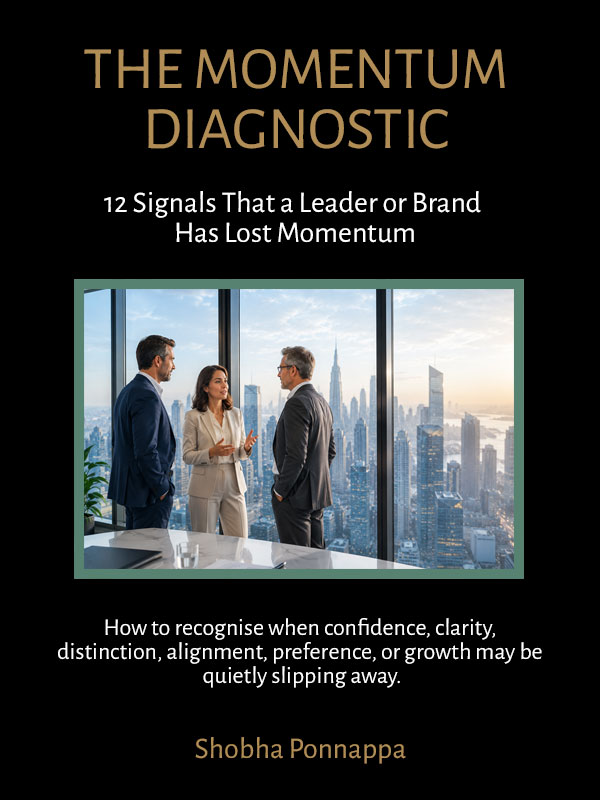
You’ll also get my weekly Breakthrough Thinking newsletter, where I examine real situations across leadership and brands, and defining shifts.

Just fill in the form to subscribe. Stay connected to how this thinking continues to evolve and unfold over time and across situations.