

A leadership team approached me after investing heavily in brand positioning, innovation, and differentiation over several years. The brand had evolved considerably, introducing capabilities, experiences, and advantages that competitors had not yet replicated. Research suggested that buyers recognised many of these strengths and often described the offering as more advanced than familiar alternatives. But while the brand had changed buyers continued evaluating it through older assumptions.
Customer conversations frequently reinforced this pattern. Buyers expressed appreciation for distinctive features and acknowledged that the offering seemed unlike others they had considered. Yet discussions repeatedly returned to benchmarks that had shaped purchasing decisions for many years. Recognition of difference was being filtered through outdated comparisons.
Most stakeholders believed the challenge lay in helping buyers appreciate how much the brand had evolved. The prevailing view was that customers simply needed more information, stronger proof points, and greater exposure to the improvements that had been introduced. Additional campaigns, refreshed messaging, and expanded content were therefore expected to increase consideration. The assumption was that better communication would eventually change buying decisions.
This belief appeared reasonable because brands often benefit from increased visibility and stronger storytelling. If buyers could see the extent of the innovation, they should theoretically become more willing to choose the offering. The difficulty was that customers were already acknowledging many of the brand’s strengths during conversations and research. Something other than awareness appeared to be influencing comparison and choice.
As the situation was examined more closely, a different pattern began to emerge. Buyers did not appear confused about the brand, nor did they question the advantages being described. Instead, they continued evaluating those advantages using standards developed for older and more familiar alternatives. The offering had evolved while the criteria used to judge it had remained largely unchanged.
This distinction proved significant. Buyers were comparing attributes, capabilities, and outcomes that no longer represented the most meaningful indicators of value. The brand had invested heavily in becoming different without paying equal attention to changing how difference itself should be assessed. Markets often preserve old habits of evaluation long after brands have moved beyond them.
Several signals pointed towards this deeper issue. Buyers frequently requested information that related more closely to conventional alternatives than to the advantages the brand considered most important. Conversations often centred on familiar measures even when stakeholders attempted to introduce broader considerations. Customers were relying on inherited standards rather than relevant ones.
Market behaviour reinforced the same conclusion. Buyers often complimented the offering, acknowledged its strengths, and agreed that it appeared distinctive before postponing decisions or choosing conventional alternatives. Nothing suggested dissatisfaction with the brand or uncertainty about its capabilities. The obstacle was not the quality of the offering … it was the framework buyers used to evaluate it.
The breakthrough came when attention shifted away from proving superiority and towards changing comparison. Instead of asking how the brand’s strengths could be communicated more persuasively, the discussion focused on identifying which criteria genuinely influenced outcomes for customers. Existing benchmarks were questioned, reframed, and in some cases discarded altogether. The objective became changing the basis of evaluation rather than defending performance against outdated measures.
Once this shift occurred, several longstanding assumptions became easier to challenge. Buyers were encouraged to assess the brand using criteria that aligned more closely with the results they actually wanted to achieve. Conversations became less focused on matching alternatives and more focused on understanding consequences and outcomes. New evaluation criteria allowed existing strengths to become commercially visible.
Many brands encounter this pattern without recognising it. They invest heavily in innovation, differentiation, and customer experience while assuming buyers will automatically adjust their methods of comparison. In reality, customers often continue relying on familiar standards because they feel safer, easier, and more widely accepted. Markets rarely change their criteria unless brands deliberately introduce better ones.
The more useful question is not always whether a brand is genuinely different. The more useful question is whether buyers have been given an appropriate way to recognise and measure that difference. Superior capabilities can remain commercially invisible when assessed through outdated assumptions. Competitive advantage sometimes depends more on reframing judgement than improving performance.
If your brand has invested significantly in innovation and differentiation but buyers continue behaving as though little has changed, communication may not be the primary issue. It may be that customers are still relying on standards that no longer reflect the value your offering creates. Additional activity often produces diminishing returns when the underlying evaluation process remains untouched. Breakthroughs frequently begin when comparison itself becomes the subject of strategic attention.
I take up work for leaders and brands through a focused 5-Day Assignment designed to create movement quickly and precisely. The process begins with a private strategy call, continues through five days of independent analysis, and concludes with a second private strategy call focused on what needs to change. The objective is not to generate more activity, but to uncover what may be preventing progress from occurring. The assignment is designed for situations that should be moving … but aren’t.

“I take up work for leaders and brands through a 5-Day Assignment designed to create movement quickly and precisely. How I work is outlined here.”
Shobha Ponnappa
Download The Momentum Diagnostic and receive weekly insights on leadership clarity, brand distinction, and direction.
Get my free Momentum Diagnostic. Discover 12 signals that may be weakening leadership or brand performance.
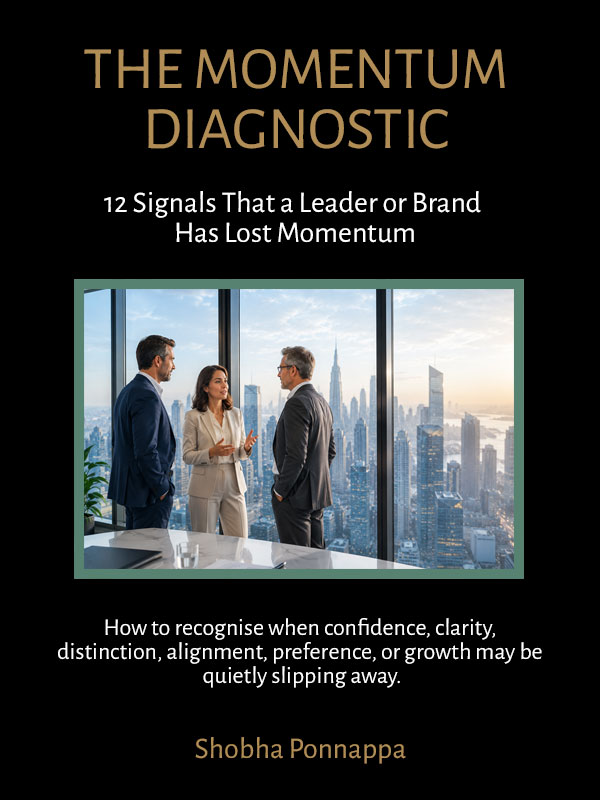
You’ll also get my weekly Breakthrough Thinking newsletter, where I examine real situations across leadership and brands, and defining shifts.
Just fill in the form to subscribe. Stay connected to how this thinking continues to evolve and unfold over time and across situations.