


Businesses that have existed for many years often become deeply woven into the routines, expectations, and assumptions of their customers and stakeholders. Teams continue delivering reliably, relationships remain cordial, and communication stays professionally consistent across multiple touchpoints. Yet over time, repeated exposure can make even valuable strengths feel increasingly ordinary. Familiarity can quietly reduce perceived significance.
This is often why leaders become puzzled when a company with a strong reputation struggles to generate renewed enthusiasm in the market. Customers may continue buying, referring, and engaging, while no longer speaking about the business with the same sense of admiration or curiosity. What was once distinctive slowly becomes treated as an expected baseline rather than an exceptional advantage. People rarely celebrate what they have stopped consciously noticing.
In many situations like this, the organisation has simply remained too close to its own capabilities for too long. Teams repeatedly communicate the same strengths, credentials, and achievements because they seem self-evidently valuable from an internal perspective. Yet audiences often become accustomed to hearing familiar claims presented in familiar ways. Repeated excellence can eventually become invisible.
Sometimes the issue lies in how brands interpret consistency. Businesses may believe maintaining the same messages indefinitely protects recognition and trust, avoiding unnecessary experimentation or repositioning. Yet customers frequently rediscover value when it is framed through a fresh perspective rather than repeated through established narratives. The story may stay true while the framing needs renewal.
You may notice it when customers describe the organisation as dependable, experienced, and highly capable, yet struggle to explain why it stands apart from alternatives. Conversations become shorter, referrals become more transactional, and long-standing relationships begin feeling habitual rather than energised. Teams may sense appreciation from the market without sensing excitement. Respect may remain strong while intrigue quietly disappears.
Sometimes the signs emerge internally. Leadership teams continue investing in content, websites, presentations, and campaigns, yet feel disappointed that these efforts produce only modest shifts in perception. New initiatives may attract polite acknowledgement but fail to create meaningful momentum or conversation. Activity alone cannot restore a sense of discovery.
When brands become overly familiar, leaders often assume the problem is insufficient promotion or insufficient frequency. Additional communication follows, alongside more updates, more announcements, and more efforts to remain visible across channels. Yet increasing exposure rarely changes perception when the underlying narrative remains unchanged. People do not rediscover value merely by seeing it more often.
Over time, this creates a subtle commercial challenge. Customers who once viewed the organisation as exceptional may gradually begin evaluating it alongside more recent entrants that present themselves with greater clarity and freshness. Competitors can appear more compelling despite possessing fewer capabilities or less experience. Remarkability requires periodic reframing rather than permanent repetition.
This is often where I work … not by changing what a business fundamentally is, but by revisiting how its value is interpreted and expressed today. The breakthrough may come from identifying strengths that have become so normal internally that nobody thinks to spotlight them anymore. Sometimes an overlooked capability becomes highly relevant when viewed through a different strategic lens. Fresh positioning often begins with rediscovering existing assets.
In my work, I frequently look for qualities that customers appreciate but no longer consciously articulate. The business may already possess authority, credibility, and differentiation, yet continuous familiarity has made these advantages blend into the background. Once those strengths are reframed and communicated with renewed precision, audiences often begin noticing them again. The goal is not reinvention … but renewed significance.
If this feels familiar, I take this up through a focused 5-Day Assignment … one 40-minute private strategy call to understand the situation, five days of independent work, and a second 40-minute private strategy call to take you through what needs to change.
Request a 5-Day Assignment here: https://shobhaponnappa.com/how-to-work-with-me/
The page outlines how I work, the assignment structure, fee range, and how to submit a brief note on your situation for review. If the fit and timing are right, I will come back to you directly. Not every situation needs this … but the right ones often benefit from a breakthrough early.
SHOBHA PONNAPPA
Breakthrough Strategist for Leaders and Brands in High-Stakes Moments
“One distinctive idea moves a brand. One defining voice moves a market.”

“I take up work for leaders and brands through a 5-Day Assignment designed to create movement quickly and precisely. How I work is outlined here.”
Shobha Ponnappa
Download The Momentum Diagnostic and receive weekly insights on leadership clarity, brand distinction, and direction.
Get my free Momentum Diagnostic. Discover 12 signals that may be weakening leadership or brand performance.
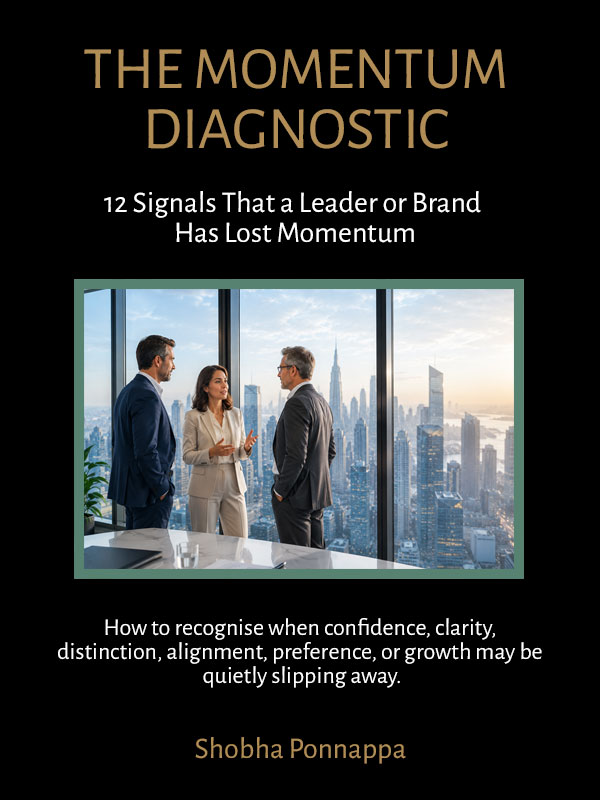
You’ll also get my weekly Breakthrough Thinking newsletter, where I examine real situations across leadership and brands, and defining shifts.
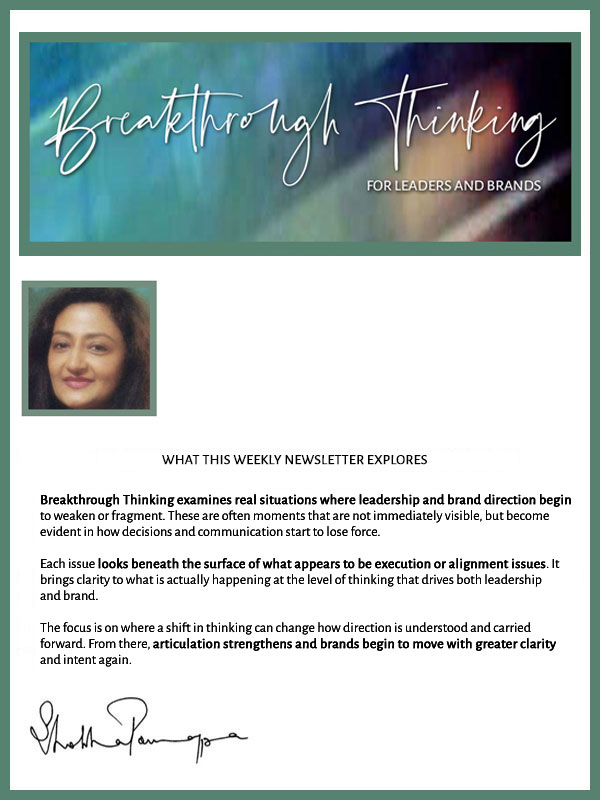
Just fill in the form to subscribe. Stay connected to how this thinking continues to evolve and unfold over time and across situations.