


Many organisations respond to slowing growth by increasing marketing activity. New campaigns appear across multiple platforms, fresh offers are introduced, and communication becomes increasingly frequent in the hope that greater visibility will generate stronger commercial momentum. Teams remain busy throughout the year without questioning whether each campaign strengthens the same strategic direction. More campaigns often create more movement without creating more momentum.
Leadership may feel encouraged because the business appears highly active in the market. Dashboards show constant launches, creative output remains high, and marketing calendars stay full for months ahead. Yet revenue growth often becomes progressively harder despite sustained promotional effort. Activity can increase while commercial leverage quietly declines.
In many cases, campaigns gradually become the strategy instead of expressing the strategy. Each new initiative is designed to solve an immediate challenge, respond to competitor activity, or pursue the latest market opportunity without reinforcing a consistent commercial narrative. Customers receive many messages but very little cumulative meaning over time. Disconnected campaigns rarely build connected market memory.
Sometimes the issue lies in how success itself is measured. Marketing teams celebrate launch dates, engagement figures, impressions, and campaign completion while giving far less attention to whether every initiative strengthens the same long-term positioning. The organisation becomes increasingly skilled at execution while becoming less disciplined about strategic coherence. Growth compounds when meaning compounds alongside activity.
The organisation may begin producing increasingly sophisticated campaigns that each perform reasonably well on their own. Individual launches receive positive feedback, creative quality improves, and short-term metrics appear encouraging, yet overall business growth remains stubbornly inconsistent. Leadership starts wondering why greater effort produces diminishing commercial returns. The campaigns succeed individually while the business struggles collectively.
Another sign appears when customers recognise recent promotions but struggle to explain what the company consistently stands for. Every campaign introduces a slightly different promise, emphasis, or priority depending on the immediate objective. Internal teams also find themselves explaining the business differently from one quarter to the next. Recognition without reinforcement rarely creates enduring preference.
As campaign volume increases, strategic attention often becomes fragmented across multiple priorities. Teams move rapidly from one launch to the next, leaving little opportunity to strengthen the underlying commercial position that every campaign should reinforce. Marketing becomes increasingly productive while long-term differentiation steadily weakens. Growth rarely accelerates when strategic focus becomes diluted.
Over time, this creates a hidden commercial cost that is not immediately visible on campaign reports. The business spends more resources generating attention because previous campaigns have left behind very little accumulated strategic equity. Each new launch must begin the persuasion process almost from the beginning. The harder marketing works, the more expensive growth eventually becomes.
This is often where I begin, not by designing another campaign, but by examining the commercial narrative that every campaign is expected to reinforce. Marketing performs very differently when each initiative contributes to a larger strategic story rather than competing for attention in isolation. Once that shared direction becomes clear, campaigns begin amplifying one another instead of replacing one another. The objective is cumulative impact rather than continuous activity.
In my work, I often look beneath visible marketing execution to understand whether the organisation is building strategic coherence or simply producing tactical volume. Businesses frequently possess strong products and capable marketing teams, yet lack the invisible organising principle that allows every campaign to compound commercial value over time. When that deeper coherence is restored, growth often becomes simpler rather than harder. The strongest campaigns usually emerge from the strongest strategic centre.
If this feels familiar, I take this up through a focused 5-Day Assignment … one 40-minute private strategy call to understand the situation, five days of independent work, and a second 40-minute private strategy call to take you through what needs to change.
Request a 5-Day Assignment here: https://shobhaponnappa.com/how-to-work-with-me/
The page outlines how I work, the assignment structure, fee range, and how to submit a brief note on your situation for review. If the fit and timing are right, I will come back to you directly. Not every situation needs this … but the right ones often benefit from a breakthrough early.
SHOBHA PONNAPPA
Breakthrough Strategist for Leaders and Brands in High-Stakes Moments
“One distinctive idea moves a brand. One defining voice moves a market.”

“I take up work for leaders and brands through a 5-Day Assignment designed to create movement quickly and precisely. How I work is outlined here.”
Shobha Ponnappa
Download The Momentum Diagnostic and receive weekly insights on leadership clarity, brand distinction, and direction.
Get my free Momentum Diagnostic. Discover 12 signals that may be weakening leadership or brand performance.
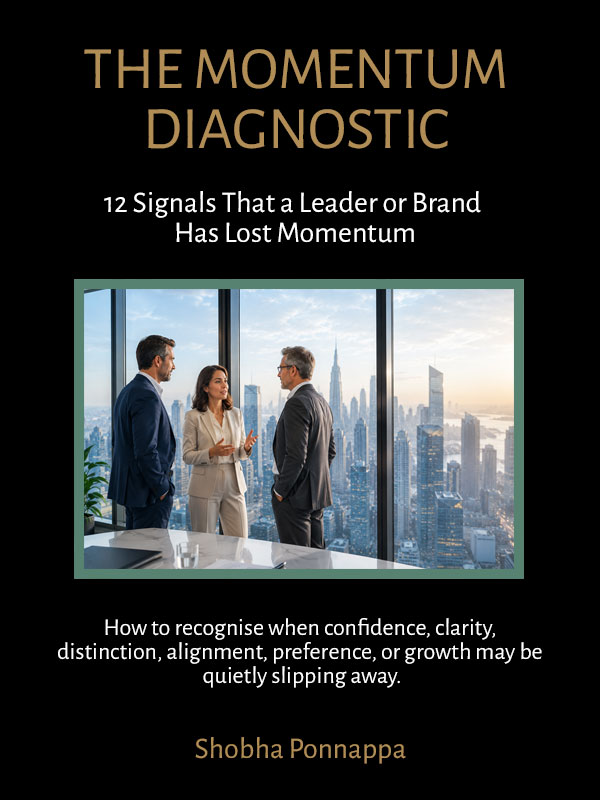
You’ll also get my weekly Breakthrough Thinking newsletter, where I examine real situations across leadership and brands, and defining shifts.
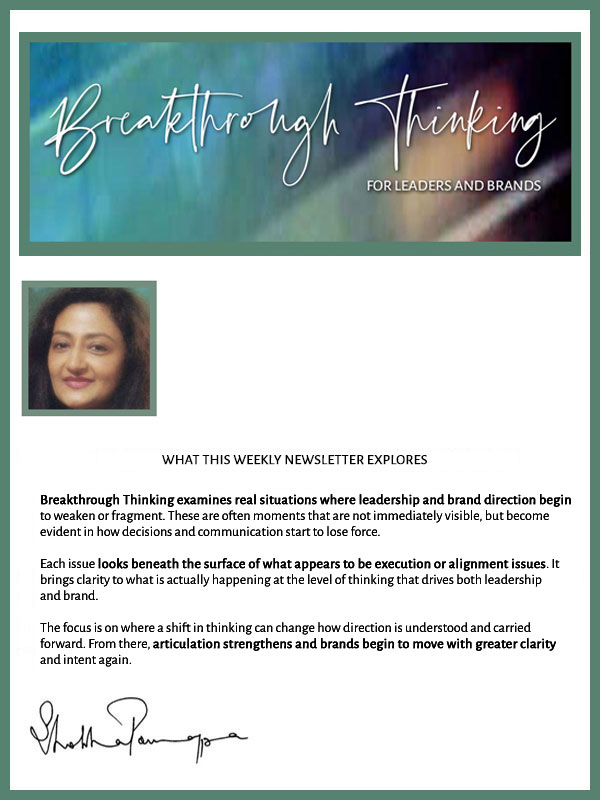
Just fill in the form to subscribe. Stay connected to how this thinking continues to evolve and unfold over time and across situations.