


Many organisations invest heavily in transformation programmes designed to modernise operations, improve customer experience, refresh positioning, and prepare the business for future growth. New technologies are introduced, new capabilities are developed, and new strategic ambitions are communicated throughout the organisation. Leadership teams often believe that visible change will naturally reshape how the market perceives the business. Transformation changes reality faster than it changes perception.
The challenge is that customers, investors, employees, and even industry observers frequently continue viewing the company through assumptions formed years earlier. They may acknowledge recent improvements while unconsciously relying on historical impressions when making decisions about trust, relevance, or credibility. The organisation becomes frustrated because current achievements seem disconnected from external recognition. Yesterday’s narrative often survives long after yesterday’s business disappears.
In many situations like this, the company focuses enormous attention on executing change while giving far less attention to narrating change. Resources may be invested in systems, products, processes, acquisitions, innovation initiatives, or cultural shifts, yet little effort is devoted to helping external audiences understand what these developments actually mean. As a result, transformation remains operational rather than perceptual. People cannot recognise a future they have not been shown.
Sometimes leadership assumes that performance improvements will eventually speak for themselves. While results certainly matter, markets rarely spend time actively updating their assumptions unless given a compelling reason to do so. Stakeholders tend to rely on familiar mental shortcuts because they reduce complexity and uncertainty. The market usually preserves old stories until a stronger story replaces them.
You may notice it when the company continues achieving milestones that would normally signal meaningful progress, yet conversations around the business remain anchored in outdated descriptions. Industry commentators may reference old strengths, old limitations, or old categories even when they no longer reflect current reality. Internal teams become increasingly puzzled by the disconnect. The organisation moves forward while the narrative remains behind.
Sometimes the signs appear through customer behaviour itself. Prospects may express surprise when they discover capabilities the company has possessed for years, or investors may underestimate strategic maturity because they still associate the business with an earlier stage of development. Employees may also struggle to articulate what the organisation has become versus what it once was. People continue buying into history rather than understanding evolution.
When outdated narratives persist, transformation delivers only a fraction of its potential value. The business may improve internally while continuing to be evaluated externally through assumptions that no longer apply. Market confidence, pricing power, partnership opportunities, and strategic influence can all be constrained by perceptions that belong to another era. A transformed company cannot fully benefit from a story that remains unchanged.
Over time, competitors may begin occupying the very territory the organisation has worked hard to build. They communicate emerging strengths more clearly, frame industry conversations more effectively, and position themselves closer to the future despite having accomplished less. The issue is not always capability. Visibility of change often matters almost as much as change itself.
This is often where I work … not by focusing only on what has changed inside the organisation, but by examining what still exists inside the market’s perception of it. The breakthrough may come from identifying the gap between present reality and inherited reputation. Once that gap becomes visible, leadership can begin addressing it deliberately rather than assuming time will solve it. Transformation succeeds commercially when perception begins catching up with reality.
In my work, I often look for the dominant story that stakeholders continue carrying forward from the company’s past. Sometimes that narrative was once useful and successful, but has now become a constraint on future growth and strategic positioning. By reframing how the organisation is understood, communicated, and remembered, the business may begin unlocking greater recognition for the value it already creates. The objective is not simply to transform the company … but to transform what the market believes about it.
If this feels familiar, I take this up through a focused 5-Day Assignment … one 40-minute private strategy call to understand the situation, five days of independent work, and a second 40-minute private strategy call to take you through what needs to change.
Request a 5-Day Assignment here: https://shobhaponnappa.com/how-to-work-with-me/
The page outlines how I work, the assignment structure, fee range, and how to submit a brief note on your situation for review. If the fit and timing are right, I will come back to you directly. Not every situation needs this … but the right ones often benefit from a breakthrough early.
SHOBHA PONNAPPA
Breakthrough Strategist for Leaders and Brands in High-Stakes Moments
“One distinctive idea moves a brand. One defining voice moves a market.”

“I take up work for leaders and brands through a 5-Day Assignment designed to create movement quickly and precisely. How I work is outlined here.”
Shobha Ponnappa
Download The Momentum Diagnostic and receive weekly insights on leadership clarity, brand distinction, and direction.
Get my free Momentum Diagnostic. Discover 12 signals that may be weakening leadership or brand performance.
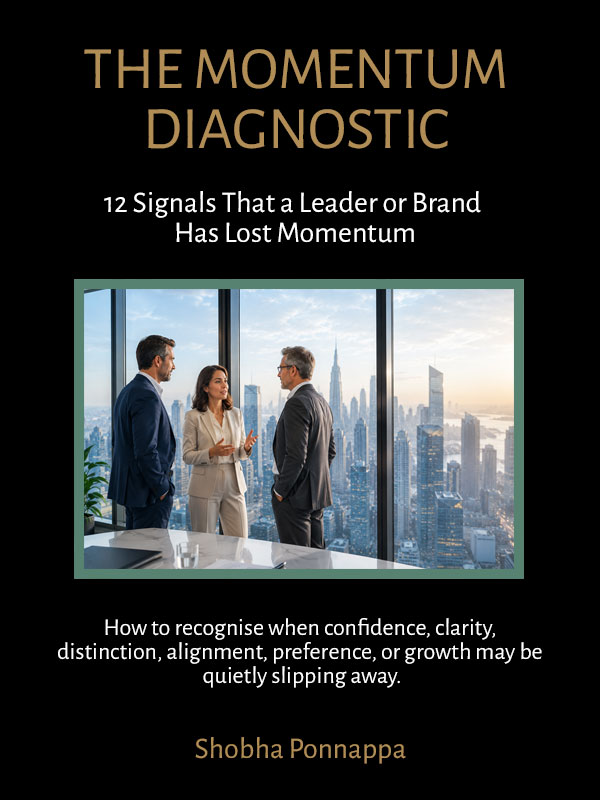
You’ll also get my weekly Breakthrough Thinking newsletter, where I examine real situations across leadership and brands, and defining shifts.
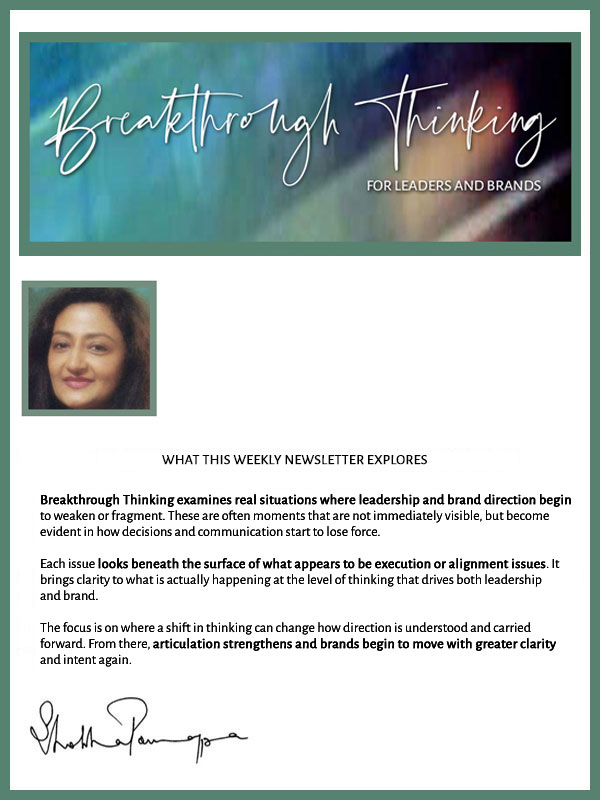
Just fill in the form to subscribe. Stay connected to how this thinking continues to evolve and unfold over time and across situations.