


As a founder, you may genuinely recognise that the business has reached a stage where more structured leadership, stronger systems, and clearer governance are necessary. Growth may now demand operational discipline beyond instinct, speed beyond personal oversight, and organisational confidence beyond founder dependency. Yet even while recognising this intellectually, you may still find yourself drawn back into decisions, approvals, and interventions that others were meant to take over. The desire to professionalise may coexist with a deep emotional difficulty in releasing control.
This tension is often more complex than simple resistance to delegation. Founders may feel they are protecting standards, preserving culture, or safeguarding the original spirit that built the company. Sometimes the organisation itself continues reinforcing this dependency by seeking reassurance from the founder even after new leadership structures are introduced. The business may outwardly appear professionalising … while emotionally remaining centred around one individual.
In many founder-led businesses, the company’s early success may have been built through direct personal judgement, fast instinctive decisions, and intense founder visibility across every important area. Over time, this may create a leadership environment where the founder becomes psychologically associated with certainty itself. Even when experienced executives are hired, the organisation may still look upward for final emotional reassurance before moving decisively. Professionalisation becomes difficult when authority transfers operationally but not psychologically.
Sometimes founders also struggle because letting go may feel emotionally similar to becoming less necessary. The business may have represented identity, relevance, purpose, and personal meaning for decades. Moving toward structured governance can therefore feel internally destabilising, even when strategically correct. The challenge may not be a lack of capability to step back … but a fear of what stepping back represents.
You may notice this pattern when senior executives appear empowered on paper yet continue seeking informal founder validation before major decisions. Meetings may repeatedly shift toward what the founder thinks, even after responsibilities have supposedly been decentralised. New leadership hires may initially appear strong but gradually become cautious around authority boundaries. The organisation may verbally support distributed leadership while behaviour continues reinforcing founder centrality.
Sometimes the signs become visible through slower institutional maturity. Teams may hesitate to take ownership independently because they are uncertain whether the founder will later reverse direction or intervene unexpectedly. Strategic initiatives may move forward unevenly because everyone is unconsciously trying to interpret the founder’s emotional position before committing fully. Decision-making may remain structurally modern … while culturally dependent.
Left unresolved, this dynamic may quietly weaken both organisational confidence and leadership succession over time. Senior leaders may begin operating defensively rather than decisively because real authority still feels emotionally concentrated elsewhere. High-quality executives may eventually disengage if they sense that accountability exists without corresponding ownership power. The organisation may struggle to scale beyond the founder’s emotional shadow.
Over time, this can also create hidden exhaustion for the founder personally. The business may continue demanding constant involvement long after the stage where such intensity is sustainable or strategically useful. Instead of building an institution capable of independent momentum, the company may remain locked in a cycle of founder reinforcement. What once created entrepreneurial strength may eventually begin limiting institutional growth.
This is often where I work less on formal organisational charts and more on the deeper articulation environment surrounding authority, reassurance, and leadership transfer inside the business. The issue may not simply be whether capable people exist within the organisation, but whether the founder’s evolving role is being clearly framed, interpreted, and understood across the leadership structure. Sometimes the organisation continues behaving dependently because the articulation around transition remains emotionally and strategically incomplete. Professionalisation often weakens when the company cannot clearly articulate where authority now sits.
In my work, these situations may require breakthrough thinking around C-Suite articulation rather than operational correction alone. The founder may still be communicating identity, authority, involvement, and reassurance in ways that unintentionally preserve dependency underneath the surface. The goal is not merely to reduce founder involvement, but to help the organisation articulate leadership continuity, institutional confidence, and decision authority more coherently across the business. Once the articulation shifts, professionalisation often begins stabilising far more naturally across the organisation.
If this feels familiar, I take this up through a focused 5-Day Assignment … one 40-minute private strategy call to understand the situation, five days of independent work, and a second 40-minute private strategy call to take you through what needs to change.
Request a 5-Day Assignment here: https://shobhaponnappa.com/how-to-work-with-me/
The page outlines how I work, the assignment structure, fee range, and how to submit a brief note on your situation for review. If the fit and timing are right, I will come back to you directly. Not every situation needs this … but the right ones often benefit from a breakthrough early.
SHOBHA PONNAPPA
Breakthrough Strategist for Leaders and Brands in High-Stakes Moments
“One distinctive idea moves a brand. One defining voice moves a market.”

“I take up work for leaders and brands through a 5-Day Assignment designed to create movement quickly and precisely. How I work is outlined here.”
Shobha Ponnappa
Download The Momentum Diagnostic and receive weekly insights on leadership clarity, brand distinction, and direction.
Get my free Momentum Diagnostic. Discover 12 signals that may be weakening leadership or brand performance.
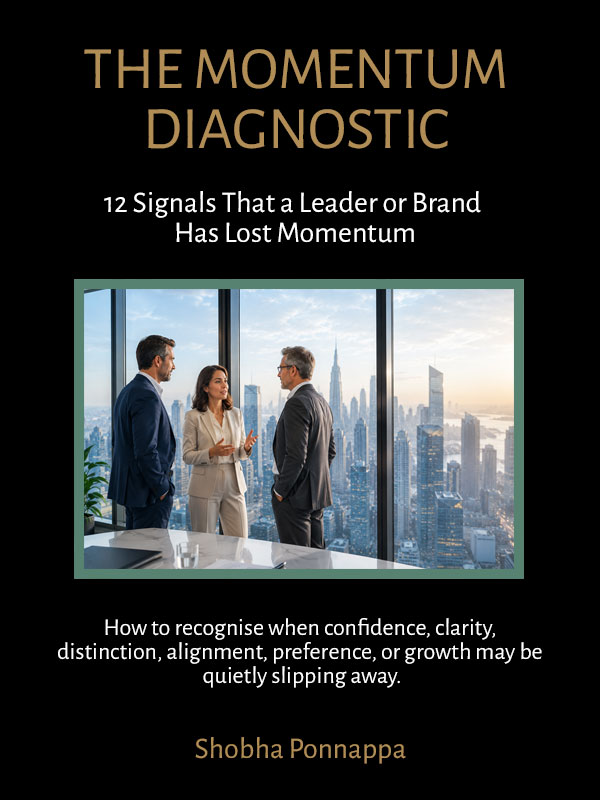
You’ll also get my weekly Breakthrough Thinking newsletter, where I examine real situations across leadership and brands, and defining shifts.
Just fill in the form to subscribe. Stay connected to how this thinking continues to evolve and unfold over time and across situations.