


As a leader in your organisation or business, you may find yourself presenting a case that appears logically sound, commercially viable, and strategically necessary, yet the support around it still feels hesitant. The numbers may hold, the rationale may be difficult to dispute, and the urgency may seem clear from your perspective. Yet commitment from others may remain cautious, fragmented, or incomplete. A strong case does not always create strong backing.
This can become deeply frustrating because the issue may not appear to lie in the quality of the proposal itself. You may feel you have already done the work required to establish credibility and direction. Yet something still feels unsettled in the room, even when no one openly disagrees. Support may appear present on the surface … while conviction underneath still feels uncertain.
In situations like this, the challenge is often not the absence of evidence or logic. It may be that the people around the decision are not yet emotionally or strategically anchored to what the decision means. They may understand the proposal intellectually, yet still hesitate to fully stand behind its implications. Understanding is not always the same as commitment.
Sometimes leaders assume that stronger data, more detailed presentations, or additional justification will eventually remove hesitation. Yet uncertainty often survives even after the evidence becomes overwhelming. This is because support is rarely built on information alone. It may depend on whether people feel psychologically aligned with the direction being taken … and confident in the frame holding it together.
You may notice this pattern when approvals move forward slowly despite broad agreement in principle. Meetings may end without direct resistance, yet follow-through remains delayed or inconsistent. Stakeholders may continue asking for more validation, more projections, or more reassurance before acting decisively. Momentum may weaken even when the argument itself remains strong.
Sometimes the signals are quieter but equally important. People may verbally support the initiative while withholding visible ownership or energy around it. Conversations may remain polite and constructive, yet lack the sense of collective confidence needed to move decisively. Alignment may appear technically present … while emotional commitment still feels incomplete.
Left unresolved, this situation may gradually erode momentum around important decisions. Leaders may find themselves carrying increasing amounts of persuasion effort simply to maintain movement. What should feel supported begins to feel continually defended. The burden of sustaining belief may remain concentrated around the leader alone.
Over time, this may create exhaustion and strategic drag inside the organisation. Teams may become cautious, execution may slow, and opportunities may begin to lose force through hesitation rather than opposition. The issue may no longer be the strength of the idea itself, but the absence of shared conviction around it. What often changes the situation is not stronger advocacy … but stronger strategic anchoring.
This is often where I work less on strengthening the visible argument and more on examining why the surrounding support structure is not solidifying around it. The issue may lie in how the decision is being framed, positioned, or emotionally held across the leadership environment. Sometimes the proposal is clear, but the larger governing narrative around it remains unstable. Support often strengthens when the underlying frame becomes more coherent.
In my work, these situations may call for breakthrough thinking rather than more persuasion effort. The goal is not simply to make the case stronger, but to create conditions where others feel able to stand behind it with greater certainty. Once the strategic framing shifts, support often begins to consolidate naturally. Conviction may rise quickly when uncertainty beneath the surface is properly addressed.
If this feels familiar, I take this up through a focused 5-Day Assignment … one 40-minute private strategy call to understand the situation, five days of independent work, and a second 40-minute private strategy call to take you through what needs to change.
Request a 5-Day Assignment here: https://shobhaponnappa.com/how-to-work-with-me/
The page outlines how I work, the assignment structure, fee range, and how to submit a brief note on your situation for review. If the fit and timing are right, I will come back to you directly. Not every situation needs this … but the right ones often benefit from a breakthrough early.
SHOBHA PONNAPPA
Breakthrough Strategist for Leaders and Brands in High-Stakes Moments
“One distinctive idea moves a brand. One defining voice moves a market.”

“I take up work for leaders and brands through a 5-Day Assignment designed to create movement quickly and precisely. How I work is outlined here.”
Shobha Ponnappa
Download The Momentum Diagnostic and receive weekly insights on leadership clarity, brand distinction, and direction.
Get my free Momentum Diagnostic. Discover 12 signals that may be weakening leadership or brand performance.
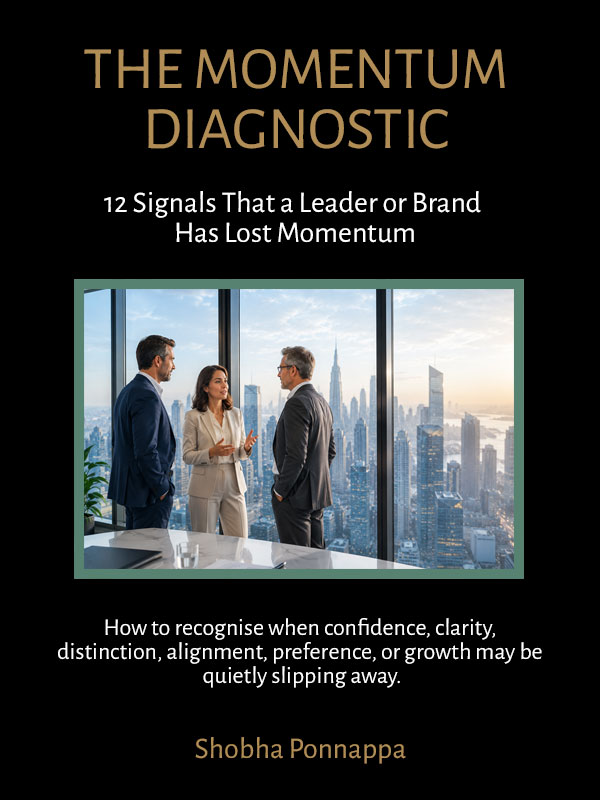
You’ll also get my weekly Breakthrough Thinking newsletter, where I examine real situations across leadership and brands, and defining shifts.
Just fill in the form to subscribe. Stay connected to how this thinking continues to evolve and unfold over time and across situations.