

Many leadership teams become concerned when a brand appears highly visible in the market yet commercial performance remains stubbornly flat. Awareness scores may be healthy, engagement may appear encouraging, and industry recognition may continue to grow. The brand seems to be attracting attention from all the right audiences. Visibility and advantage are often mistaken for the same thing.
This confusion creates a dangerous sense of progress because activity remains visible even when commercial impact does not. Marketing teams continue generating reach, content performs well, and the organisation receives regular signs that people are noticing the brand. Yet competitors continue gaining ground despite receiving less attention. Attention only matters when it alters competitive behaviour.
Many organisations assume that increased visibility naturally leads to increased demand. The logic appears reasonable because people cannot choose what they do not notice. However, visibility only creates opportunity rather than preference. Growth occurs when awareness becomes meaningful differentiation.
Customers are exposed to thousands of messages every day. Being seen is therefore only the beginning of the commercial journey rather than its conclusion. Brands that grow consistently tend to occupy a distinct position in the customer’s mind. Recognition without preference rarely changes buying decisions.
Awareness is valuable because it creates market access. A brand that remains invisible cannot realistically influence consideration or choice. The problem begins when awareness becomes the primary measure of success. Visibility is an asset, not a strategy.
Many brands become trapped in a cycle of pursuing greater exposure without examining what that exposure is actually accomplishing. They celebrate reach, impressions, and engagement while overlooking changes in customer behaviour. As a result, performance indicators appear healthy even as commercial outcomes remain unchanged. The metric can improve while the business stands still.
Growth is often driven by clarity rather than volume. Competitors may be less visible overall while communicating a more compelling reason to choose them. Their position may be easier to understand, easier to remember, and easier to act upon. Distinctiveness frequently outperforms visibility.
Customers rarely evaluate every available option in detail. Instead, they rely on mental shortcuts that simplify decision-making. Brands that create stronger associations around a specific value, problem, or outcome often gain disproportionate advantage. The most remembered brand is not always the most noticed one.
The hidden issue is often that the brand has become visible without becoming strategically meaningful. Audiences recognise it, but they do not attach a sufficiently compelling reason to choose it. The organisation therefore earns attention without earning advantage. The market may know the brand without needing the brand.
This usually happens when messaging focuses on activity, expertise, or presence rather than strategic distinction. The brand explains what it does but not why it matters more than alternatives. Customers understand the offer while remaining indifferent to the choice. Familiarity does not automatically create relevance.
The turning point often arrives when leaders stop measuring how visible the brand is and start examining how influential it has become. This shifts attention from exposure towards competitive positioning. The conversation becomes less about reach and more about preference. Advantage begins where visibility stops.
Once organisations identify the gap between recognition and choice, different questions emerge. Leaders begin exploring what customers truly associate with the brand and what competitors cannot easily replicate. Strategic focus moves from being noticed to being preferred. Growth accelerates when distinction becomes difficult to ignore.
Situations like this often create confusion because the visible indicators appear encouraging. Teams see evidence that marketing is working and struggle to understand why commercial momentum remains weak. The organisation feels active, visible, and present in the market. The appearance of progress can sometimes conceal the absence of advantage.
I take up work for leaders and brands through a focused 5-Day Assignment designed to create movement quickly and precisely. The process begins with a private strategy call, continues through five days of independent analysis, and concludes with a second private strategy call focused on what needs to change. The objective is not to add more activity, but to uncover what may be preventing progress from occurring. The assignment is designed for situations that should be growing, but aren’t.

“I take up work for leaders and brands through a 5-Day Assignment designed to create movement quickly and precisely. How I work is outlined here.”
Shobha Ponnappa
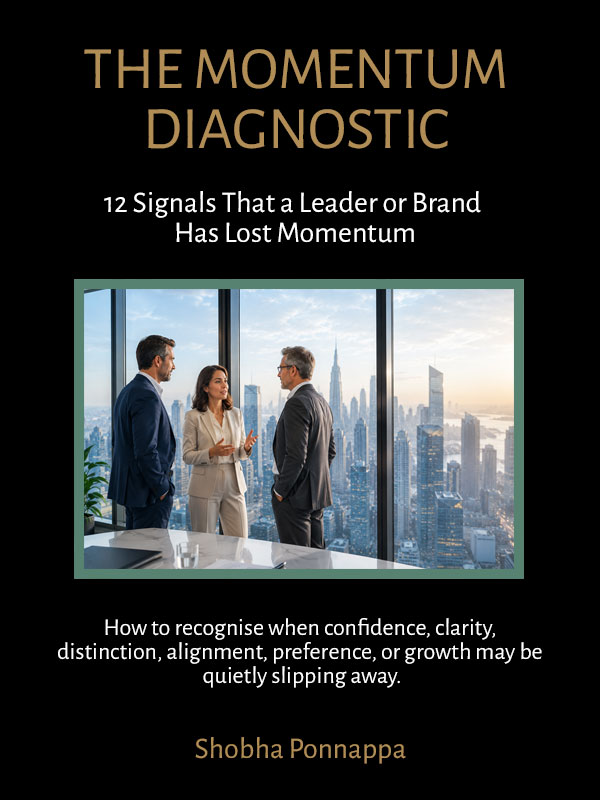
Download The Momentum Diagnostic and receive weekly insights on leadership clarity, brand distinction, and direction.
Get my free Momentum Diagnostic. Discover 12 signals that may be weakening leadership or brand performance.
You’ll also get my weekly Breakthrough Thinking newsletter, where I examine real situations across leadership and brands, and defining shifts.

Just fill in the form to subscribe. Stay connected to how this thinking continues to evolve and unfold over time and across situations.