


As leadership teams, you may genuinely believe you are communicating ambition, evolution, and future readiness when speaking about transformation. The intent may be to energise the organisation around growth, innovation, restructuring, or strategic reinvention. Yet inside the company, employees may not always hear confidence, clarity, or opportunity in the same way leadership intends. Instead, many may quietly hear uncertainty about what becomes unstable next.
This disconnect often emerges because transformation language carries emotional weight far beyond the formal strategy itself. Leaders may focus on the destination while employees focus on what may disappear along the journey. Teams may begin interpreting every new initiative, structural change, or strategic announcement as a possible signal of disruption, loss of relevance, or internal instability. The organisation may outwardly support transformation … while internally processing anxiety.
In many organisations, transformation communication becomes heavily weighted toward strategic aspiration but lightly articulated around emotional reassurance. Leadership teams may discuss agility, reinvention, acceleration, and future readiness without fully recognising how these words are interpreted further down the organisation. Employees may not automatically experience these messages as inspiring because they are simultaneously evaluating implications for roles, identity, security, and influence. Transformation language may therefore activate organisational uncertainty beneath strategic language.
Sometimes the issue is also cumulative rather than immediate. Teams may already have experienced repeated restructuring cycles, shifting priorities, leadership changes, or contradictory strategic directions over time. As a result, employees may begin hearing transformation announcements through the memory of previous instability rather than through current leadership intention. The organisation may intellectually understand the strategy … while emotionally preparing for disruption.
You may notice this pattern when employees become unusually cautious after leadership communication about transformation initiatives. Meetings may become quieter, experimentation may reduce, and decision-making may slow because people are unconsciously trying to assess organisational risk. Informal conversations may increasingly revolve around restructuring speculation, role security, or leadership intentions rather than strategic excitement. The organisation may verbally support transformation while behaviour begins signalling heightened emotional defensiveness.
Sometimes the signs appear through fragmentation across departments and leadership layers. Middle managers may begin translating transformation messages inconsistently because they themselves remain uncertain about future implications. Teams may interpret silence, ambiguity, or evolving priorities as indicators that larger changes are coming without being fully disclosed. Organisational alignment may weaken not because people oppose transformation … but because uncertainty starts spreading faster than clarity.
Left unresolved, this dynamic may quietly weaken organisational confidence at precisely the stage where transformation requires the highest levels of collective trust and momentum. Employees may begin focusing more on self-protection than contribution because the emotional environment no longer feels fully predictable. Strong performers may disengage psychologically even before visible attrition begins. The business may struggle to sustain institutional confidence during transition.
Over time, this may also reduce leadership credibility itself. When transformation messaging repeatedly creates anxiety rather than clarity, employees may begin interpreting future communication through suspicion instead of trust. Even strategically correct initiatives may encounter passive resistance because the emotional narrative surrounding change has become unstable. What leadership intends as forward movement may gradually begin generating organisational hesitation instead.
This is often where I work less on formal change-management language and more on the deeper articulation environment surrounding leadership communication, emotional reassurance, and strategic interpretation across the organisation. The issue may not simply be whether the transformation strategy is sound, but whether the organisation emotionally understands how stability, continuity, and future confidence are being framed during change. Sometimes uncertainty grows because leadership communicates direction without fully articulating reassurance. Transformation often weakens when the organisation cannot clearly interpret what remains stable during change.
In my work, these situations may require breakthrough thinking around C-Suite articulation rather than communication amplification alone. Leadership teams may unintentionally communicate urgency, reinvention, or disruption in ways that create emotional ambiguity underneath the surface. The goal is not merely to announce transformation more frequently, but to help the organisation articulate continuity, confidence, and strategic meaning more coherently during periods of change. Once the articulation shifts, transformation often begins stabilising far more naturally across the organisation.
If this feels familiar, I take this up through a focused 5-Day Assignment … one 40-minute private strategy call to understand the situation, five days of independent work, and a second 40-minute private strategy call to take you through what needs to change.
Request a 5-Day Assignment here: https://shobhaponnappa.com/how-to-work-with-me/
The page outlines how I work, the assignment structure, fee range, and how to submit a brief note on your situation for review. If the fit and timing are right, I will come back to you directly. Not every situation needs this … but the right ones often benefit from a breakthrough early.
SHOBHA PONNAPPA
Breakthrough Strategist for Leaders and Brands in High-Stakes Moments
“One distinctive idea moves a brand. One defining voice moves a market.”

“I take up work for leaders and brands through a 5-Day Assignment designed to create movement quickly and precisely. How I work is outlined here.”
Shobha Ponnappa
Download The Momentum Diagnostic and receive weekly insights on leadership clarity, brand distinction, and direction.
Get my free Momentum Diagnostic. Discover 12 signals that may be weakening leadership or brand performance.
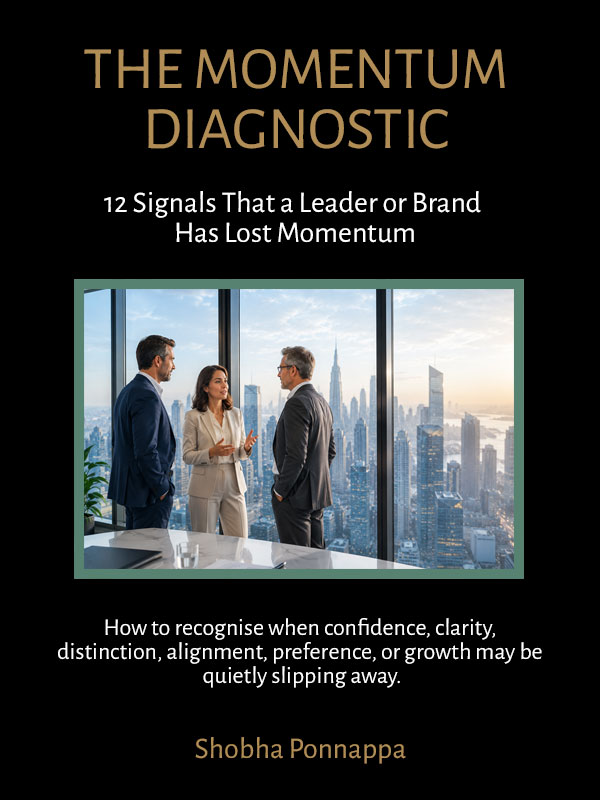
You’ll also get my weekly Breakthrough Thinking newsletter, where I examine real situations across leadership and brands, and defining shifts.
Just fill in the form to subscribe. Stay connected to how this thinking continues to evolve and unfold over time and across situations.