
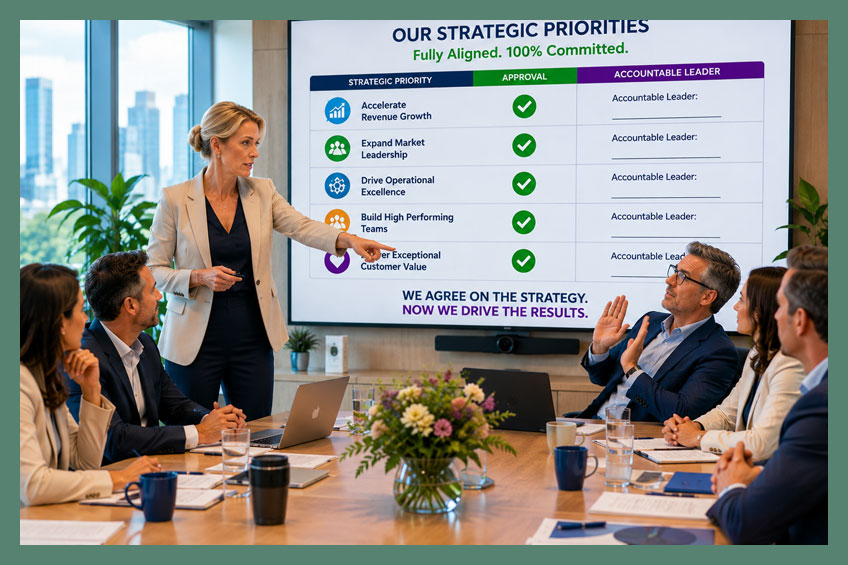
A senior leadership team approached me after completing a major strategic planning process involving months of workshops, reviews, and stakeholder discussions. The resulting strategy was widely praised internally and had received visible support from executives across the organisation. There was little disagreement regarding direction, priorities, or ambition. The strategy appeared aligned, yet progress remained unexpectedly slow.
The organisation initially believed execution challenges were responsible for the lack of momentum. Additional meetings were scheduled, project reviews became more frequent, and leaders repeatedly reaffirmed their commitment to the agreed direction. Despite these efforts, critical initiatives continued to drift and important milestones were regularly missed. Support existed throughout the organisation, but ownership remained unclear.
Most stakeholders believed alignment was the primary requirement for successful execution. Once leaders agreed on priorities and endorsed the strategy, progress was expected to follow naturally. Consensus was therefore viewed as evidence that implementation risks had been largely resolved. The assumption was that agreement automatically creates accountability.
This belief seemed entirely reasonable on the surface. Teams were engaged, leaders spoke positively about the strategy, and few visible conflicts emerged during decision-making discussions. The organisation interpreted widespread support as proof that responsibility had been embedded throughout the business. Shared commitment was being mistaken for assigned ownership.
A different pattern began to emerge as implementation activity was examined more closely. Strategic initiatives often involved multiple functions, multiple leaders, and overlapping responsibilities. Everyone considered the objectives important, yet nobody felt personally accountable for ensuring they happened. The strategy belonged to everyone in principle and no one in practice.
This distinction proved critical. Teams could explain the priorities, articulate the goals, and describe the desired outcomes with impressive consistency. What they could not consistently identify was the individual responsible for driving each outcome to completion. Clarity of direction had not been matched by clarity of accountability.
Several signals pointed towards this deeper issue. Strategic updates frequently focused on activity rather than outcomes, and discussions often revolved around what had been attempted rather than what had been achieved. When obstacles emerged, conversations tended to shift across functions rather than towards a single accountable leader. Responsibility was circulating rather than settling.
Meeting behaviour reinforced the same conclusion. Decisions were generally well supported, yet follow-through varied considerably between initiatives. Teams assumed action would occur because the strategy had been endorsed, while accountability remained dispersed across multiple stakeholders. The organisation had commitment without ownership.
The breakthrough came when the conversation moved away from alignment and towards accountability. Instead of asking whether leaders supported each initiative, attention shifted towards identifying who was personally responsible for delivering each outcome. This changed both the structure of execution and the quality of decision-making. The focus moved from collective endorsement to individual ownership.
Once this shift occurred, implementation became significantly easier to manage. Strategic priorities were assigned clear owners, success measures were linked to named leaders, and progress reviews became far more objective. Ambiguity diminished because accountability now had a visible home. The strategy stopped being everybody’s responsibility and started becoming someone’s responsibility.
Many organisations underestimate the difference between support and ownership. Strong alignment often creates a sense of confidence that masks deeper execution risks. Teams assume that because everyone agrees, progress will naturally occur. Execution succeeds through accountability more reliably than consensus.
The more useful question is often not whether people support the strategy. The more useful question is whether every critical outcome has an owner who is clearly accountable for delivery. Alignment creates possibility, but accountability creates movement. Strategies advance when responsibility becomes unmistakable.
If your organisation appears strategically aligned but continues struggling to convert plans into results, the issue may not be the quality of the strategy itself. It may be that accountability has never been clearly assigned. In situations like this, additional meetings and communication often produce limited improvement. The breakthrough usually begins when ownership becomes visible.
I take up work for leaders and organisations through a focused 5-Day Assignment designed to create movement quickly and precisely. The process begins with a private strategy call, continues through five days of independent analysis, and concludes with a second private strategy call focused on what needs to change. The objective is not to generate more activity, but to uncover what may be preventing progress from occurring. The assignment is designed for situations where commitment exists, but execution does not.

“I take up work for leaders and brands through a 5-Day Assignment designed to create movement quickly and precisely. How I work is outlined here.”
Shobha Ponnappa
Download The Momentum Diagnostic and receive weekly insights on leadership clarity, brand distinction, and direction.
Get my free Momentum Diagnostic. Discover 12 signals that may be weakening leadership or brand performance.
You’ll also get my weekly Breakthrough Thinking newsletter, where I examine real situations across leadership and brands, and defining shifts.
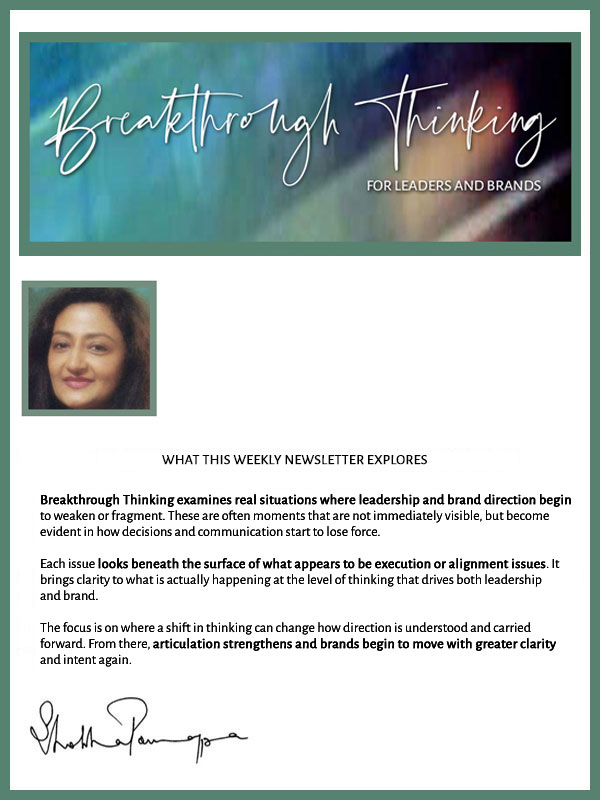
Just fill in the form to subscribe. Stay connected to how this thinking continues to evolve and unfold over time and across situations.