
There are situations where CEOs sustain a strong and consistent performance flow, yet begin to experience a subtle weakening of authority across board and organisation. This typically shows up as repeated requests for clarification, growing dependence on explanation, and a lack of cumulative conviction despite continued delivery. The issue is rarely performance itself, but whether leadership judgement is being articulated in a way that can travel and hold under scrutiny. This case study examines how authority can quietly leak even as performance appears steady, and what needs to shift for leadership credibility to stabilise.
I examine how a CEO sustained strong performance flow while authority quietly weakened … and how I reframed articulation for credibility.
The CEO was leading a business that had entered a period of sustained operational strength, with performance flow remaining consistent across multiple quarters. Revenue progression, execution discipline, and delivery predictability were all holding firmly. Internally, teams were aligned and execution rarely faltered under pressure. The organisation appeared stable and forward-moving on all visible metrics.
Across board interactions and senior leadership forums, however, a different pattern was beginning to surface. Questions returned to previously addressed decisions, and strategic direction required repeated reinforcement. The CEO found himself needing to re-explain choices that had already delivered results. Authority was not accumulating in proportion to performance flow.
What I observed was not a failure of strategy or execution, but a misalignment between performance continuity and interpretive framing. The CEO’s judgement was producing outcomes that validated his direction under varying conditions. However, those outcomes were being presented as evidence of delivery rather than expressions of a consistent decision logic. Performance was visible, but the thinking that generated it was not.
In environments where scrutiny is ongoing, authority does not come from sustained output alone. It comes from whether that output is understood as the result of stable and repeatable judgement. When articulation does not make this logic explicit, each period of performance stands alone rather than building into a pattern. The absence of articulated continuity created a slow leak in perceived authority.
I reframed the issue away from strengthening reporting structures or adding explanatory layers. The work was not about defending performance with greater detail or increasing visibility of metrics. It was about shifting how leadership judgement was carried through articulation so that performance flow could be understood as the natural consequence of consistent thinking. The CEO needed to make his decision logic legible across time.
Working closely with the CEO, I helped reshape how ongoing performance was positioned in relation to judgement. Each articulation linked past decisions, present outcomes, and future direction into a single continuous logic. Language was stabilised so that meaning did not reset with each interaction. Performance flow became evidence of a continuing and reliable judgement spine.
At C-suite level, sustained performance is expected, but it is not sufficient to secure authority. Boards and senior stakeholders are evaluating whether leadership judgement will hold under future uncertainty. When that judgement is not clearly articulated, even strong performance can be interpreted as conditional or situational. Authority depends on the perceived durability of thinking, not just the consistency of results.
For this CEO, the risk was not deterioration in performance, but erosion in how that performance was interpreted. Without visible continuity of judgement, confidence could not extend beyond what had already been delivered. This created a structural gap between execution strength and leadership credibility. The leak in authority sat within interpretation, not within performance itself.
Here are ten directions that changed the nuances of articulation:
CONFIDENTIALITY CAVEAT: This essay reflects an anonymised leadership situation drawn from long-term exposure to senior decision-making environments. Specific individuals, organisations, and timelines have been intentionally withheld to preserve discretion.

“I take up work for leaders and brands through a 5-Day Assignment designed to create movement quickly and precisely. How I work is outlined here.”
Shobha Ponnappa
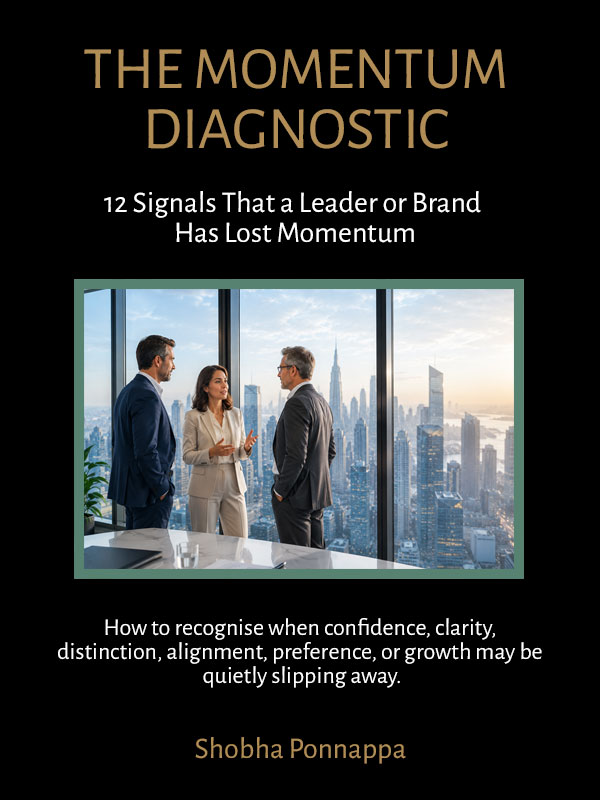
Download The Momentum Diagnostic and receive weekly insights on leadership clarity, brand distinction, and direction.
Get my free Momentum Diagnostic. Discover 12 signals that may be weakening leadership or brand performance.
You’ll also get my weekly Breakthrough Thinking newsletter, where I examine real situations across leadership and brands, and defining shifts.
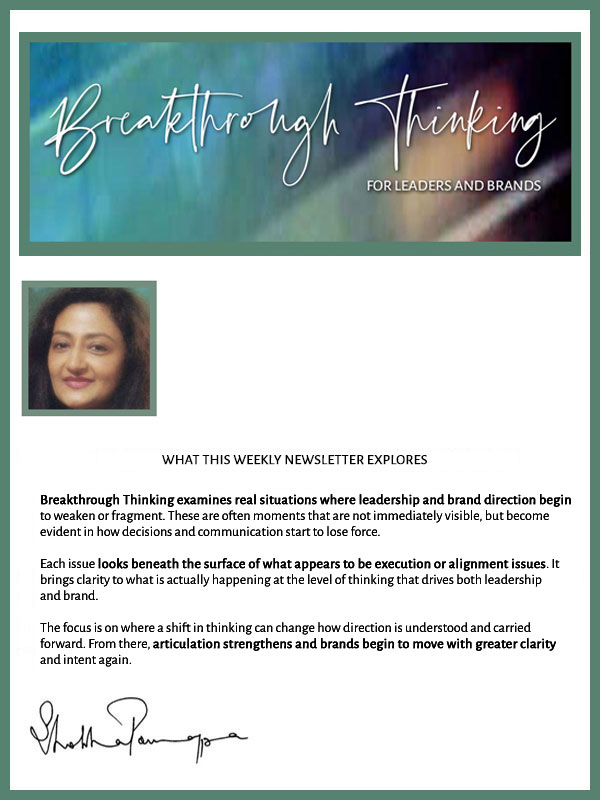
Just fill in the form to subscribe. Stay connected to how this thinking continues to evolve and unfold over time and across situations.