

There are situations where a clear and well-reasoned strategy does not translate into alignment across a growing organisation. This typically shows up as differing interpretations, fragmented execution, and a loss of coherence as the strategy moves through teams and layers. The issue is rarely the quality of the strategy itself, but whether leadership judgement has been articulated clearly enough to survive scale, communication, and interpretation. This case study examines how strategic clarity can dissolve even when direction is sound, and what needs to shift for coherence to hold.
I reveal how a Tech Founder-CEO’s clear strategy lost coherence once it was written and shared at scale … and how I restored clarity.
The Founder-CEO led a fast-scaling technology platform with a strategically sound direction agreed at board level. The strategy was future-facing and well reasoned, and it had been communicated through decks, town halls, and leadership cascades. From the centre, clarity felt established and complete. Yet across the organisation, the strategy arrived as confusion rather than direction.
Teams interpreted priorities differently, senior leaders emphasised competing signals, and execution paths began to diverge. The Founder-CEO noticed increasing variation in how the strategy was described back to him in meetings and reviews. Alignment appeared present, but coherence was not. Strategic intent was not travelling intact once it left the top.
What I observed was not a failure of strategic thinking. The Founder-CEO’s judgement was sound, internally consistent, and responsive to market realities. The issue lay in how that judgement was being carried once it entered written and spoken communication. Strategy had been explained, but it had not been articulated precisely enough to survive interpretation.
In platform businesses, intent degrades quickly when meaning is left implicit. Each layer adds its own assumptions and emphasis, often unconsciously. Over time, strategy becomes inferred rather than held. Clarity was assumed instead of being deliberately carried through language leaders and teams relied on to act.
I reframed the problem away from communication volume or alignment sessions. The work was not about repeating the strategy more often or simplifying it further. It was about articulating the leadership judgement that shaped the strategy in the first place, and carrying that judgement consistently into writing.
Working directly with the Founder-CEO, I helped translate intent into explicit framing that could travel through decks, leadership narratives, and internal articulation. We shifted focus from what the strategy stated to what it prioritised, protected, and deliberately excluded. By making trade-offs and reasoning visible in language, intent became harder to distort as it moved outward. Strategy regained shape because judgement, not summary, was doing the work.
At C-suite level, strategic intent must survive distance, scale, and speed. Leaders cannot personally correct every misinterpretation that emerges as organisations grow. Authority depends on whether intent is articulated clearly enough to self-correct as it travels. Judgement that is not expressed explicitly becomes negotiable.
For this Founder-CEO, the risk was not disagreement but fragmentation. Without articulated judgement, teams optimised locally while believing they were aligned globally. This was not an execution failure, but an articulation gap. Restoring clarity at the source protected coherence without adding control or slowing momentum.
Here are ten directions that changed the nuances of articulation:
Articulating intent before outcomes: I encouraged the Founder-CEO to state what the strategy was designed to achieve before describing initiatives.
Making trade-offs unmistakable: I helped explicitly name what the strategy excluded, not only what it pursued.
Replacing summaries with framing: I guided a shift away from condensed statements toward articulated interpretive frames leaders could carry forward.
Stating priorities relationally: I helped express how priorities ranked against one another, rather than listing them equally.
Reducing interpretive freedom across layers: I tightened language where teams had been filling gaps with local assumptions.
Naming the logic of sequencing: I encouraged articulation of why things needed to happen in a particular order.
Stabilising language across forums: I ensured consistent phrasing so intent did not mutate between decks, meetings, and discussions.
Separating aspiration from direction: I reframed how ambition was expressed so vision did not blur into instruction.
Holding intent steady under discussion: I helped the Founder-CEO maintain articulated judgement even as debate unfolded.
Letting articulation carry coherence: I repositioned clarity as the mechanism through which alignment would occur naturally.
Strategic coherence increased, with fewer conflicting interpretations of direction.
Decision-making accelerated, as intent no longer required repeated clarification.
Leadership alignment improved without additional controls or governance layers.
Momentum became more predictable, as strategy travelled with its meaning intact.
CONFIDENTIALITY CAVEAT: This essay reflects an anonymised leadership situation drawn from long-term exposure to senior decision-making environments. Specific individuals, organisations, and timelines have been intentionally withheld to preserve discretion.

“I take up work for leaders and brands through a 5-Day Assignment designed to create movement quickly and precisely. How I work is outlined here.”
Shobha Ponnappa
Download The Momentum Diagnostic and receive weekly insights on leadership clarity, brand distinction, and direction.
Get my free Momentum Diagnostic. Discover 12 signals that may be weakening leadership or brand performance.
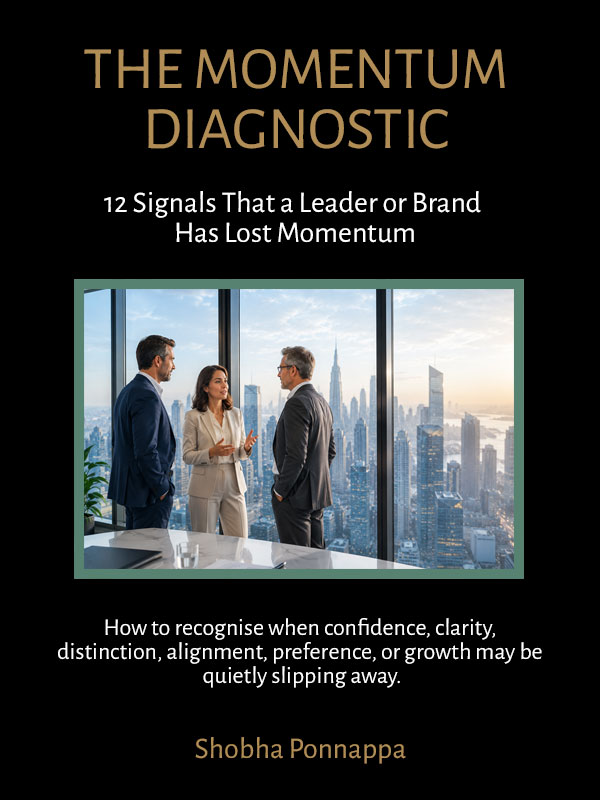
You’ll also get my weekly Breakthrough Thinking newsletter, where I examine real situations across leadership and brands, and defining shifts.
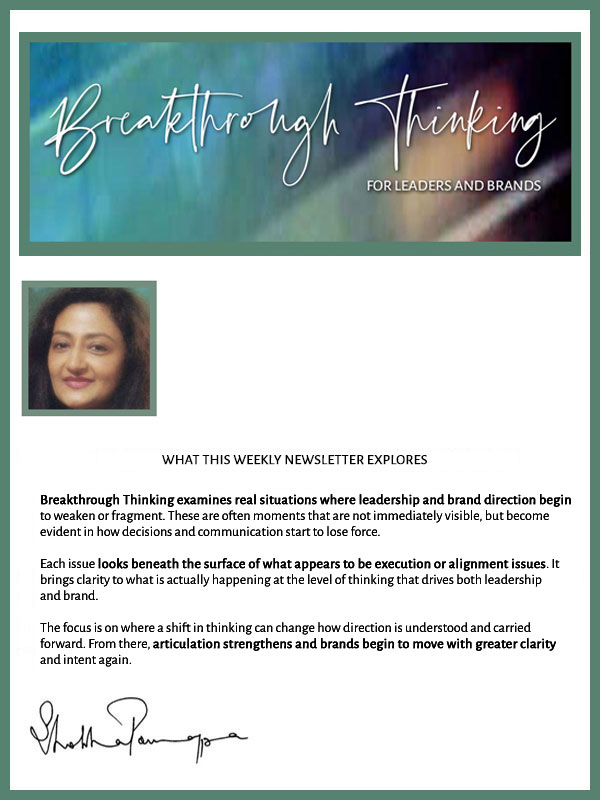
Just fill in the form to subscribe. Stay connected to how this thinking continues to evolve and unfold over time and across situations.