

I answer 6 tough questions about why leadership authority can weaken even when results remain strong and sustained.
I often work with CEOs and founders whose organisations are delivering solid numbers but struggling to hold alignment. On the surface, performance indicators look reassuring. Yet decisions are increasingly debated, interpreted, or second-guessed once they are written, presented, and circulated through the system.
Authority rarely collapses because leaders fail visibly. It weakens when outcomes continue to land but the reasoning behind decisions is no longer clearly articulated or carried forward through leadership communication. Teams comply, but they no longer internalise judgement. Over time, this creates results without interpretive ownership.
Strong results can mask early warning signals because they delay scrutiny. Leaders assume credibility is intact because performance continues. Meanwhile, decisions require repeated explanation, rewriting, and reframing across decks, messages, and discussions.
One early sign is when decisions are technically followed but emotionally resisted. Another is when senior leaders find themselves repeatedly clarifying intent after decisions have already been written, announced, or presented. Meetings multiply, yet conviction does not. These are indicators of judgement no longer travelling cleanly.
You may also notice that leaders closest to execution begin improvising around decisions rather than anchoring to them. This is not rebellion, but interpretation drift. Authority weakens first at the level of meaning, not behaviour. That subtle shift marks the start of signal dilution.
Results validate effort, not judgement. When outcomes are favourable, organisations stop interrogating how decisions are being understood. Leaders assume credibility is intact because performance continues, even as judgement is no longer landing cleanly through their written and spoken articulation.
Over time, teams rely more on precedent than on present judgement. Authority becomes historical rather than active. When conditions change, leaders discover their judgement no longer commands immediate trust. At that point, results can no longer compensate for weakened authority.
Under pressure, leaders compress explanation, move faster, and over-summarise judgement in writing and presentation. What often gets lost is the articulation of why a decision matters now. Teams receive conclusions without context. That gap quietly erodes shared interpretive ground.
As complexity increases, authority depends less on position and more on clarity. When articulation thins, interpretation fills the vacuum. Decisions still land, but their meaning fractures across functions. This fragmentation is how pressure converts into authority loss.
Founders often experience this when organisations outgrow informal alignment. What once travelled intuitively now requires articulation. Without that shift, authority becomes personality-dependent rather than judgement-based. This leads to founder authority strain under scale.
Professional CEOs face a different risk. They may inherit credibility through role and results, but struggle to establish interpretive ownership. When judgement is not distinctly articulated, authority remains provisional. Over time, that creates role-based authority without depth.
Yes, but only through deliberate articulation, not reinforcement. Authority returns when leaders clarify how judgement is formed, and carry that reasoning consistently into how decisions are written, presented, and shared. This re-anchors trust in reasoning rather than outcomes. That shift restores decision legitimacy at the source.
The work is subtle and often invisible. It focuses on how leaders speak, frame trade-offs, and signal intent under pressure. When judgement starts travelling cleanly again, authority follows naturally. This is how clarity precedes renewed leadership weight. It involves shaping how judgement is articulated in language others rely on to act, not producing content for visibility.
If this pattern feels familiar, leadership may not be failing … but it is thinning. Authority erodes long before performance signals trouble. The remedy is not louder communication, but sharper judgement articulation carried into the words leaders use to decide, align, and lead. Addressed early, clarity can restore authority before results are forced to carry the burden.

“I take up work for leaders and brands through a 5-Day Assignment designed to create movement quickly and precisely. How I work is outlined here.”
Shobha Ponnappa
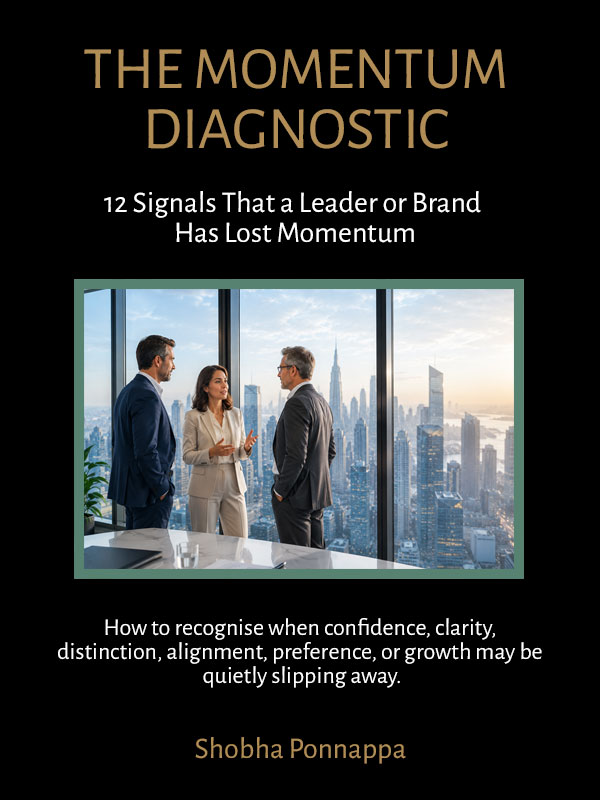
Download The Momentum Diagnostic and receive weekly insights on leadership clarity, brand distinction, and direction.
Get my free Momentum Diagnostic. Discover 12 signals that may be weakening leadership or brand performance.
You’ll also get my weekly Breakthrough Thinking newsletter, where I examine real situations across leadership and brands, and defining shifts.

Just fill in the form to subscribe. Stay connected to how this thinking continues to evolve and unfold over time and across situations.