

Many organisations spend years improving their products, expanding their capabilities, strengthening leadership, and refining the way they operate. New expertise is acquired, new services emerge, and strategic priorities become more sophisticated over time. Yet customers often continue viewing the business through assumptions formed many years earlier. Businesses may evolve faster than the perceptions surrounding them.
This often surprises leadership teams because internally the transformation feels obvious and substantial. The organisation sees the investments it has made, the expertise it has accumulated, and the complexity it now handles with confidence. Outside the business, however, many stakeholders continue relying on outdated mental pictures formed long before those changes occurred. Reality changes first … perception follows much later.
In many cases, organisations assume that operational progress automatically updates market perception. Leaders focus on improving delivery, strengthening systems, recruiting better talent, and introducing new capabilities while expecting customers to naturally notice the difference. Yet perception rarely changes simply because the business itself has changed. Markets respond to communicated meaning rather than invisible progress.
Sometimes the organisation continues speaking about itself using language that belonged to an earlier stage of its development. The company may still describe its work, expertise, or value in ways that no longer reflect its present capability or strategic ambition. Customers therefore continue placing the business inside an outdated category even while its actual contribution has become far more valuable. Old narratives often preserve old perceptions.
You may notice it when conversations repeatedly revolve around services or capabilities the business has long since outgrown. Prospective clients continue asking about work the company no longer wishes to be known for while overlooking newer, more strategic strengths. Teams become frustrated because the market seems slow to recognise what the organisation has already become. The business moves ahead … but reputation remains behind.
Sometimes the evidence appears in the opportunities themselves. Higher-value work may fail to materialise because potential clients continue viewing the organisation through an outdated frame of reference rather than its current strategic positioning. Even satisfied customers may introduce the business using descriptions that belonged to another chapter in its history. Yesterday’s positioning quietly shapes today’s opportunities.
When perception lags behind reality, businesses often respond by working even harder instead of communicating differently. More qualifications are added, more services are introduced, and more operational improvements are made without addressing the outdated narrative held by the market. Unfortunately, stronger capability alone rarely corrects an inaccurate perception. Growth becomes constrained by inherited assumptions.
Over time, this creates a hidden commercial disadvantage. The organisation may possess the expertise to compete for larger opportunities, yet continue attracting work associated with an earlier version of itself. Competitors with weaker capabilities but clearer positioning may increasingly win attention and trust. Perception frequently determines opportunity before capability is ever evaluated.
This is often where I work … not by asking how the business can promote itself more aggressively, but by examining whether its external narrative still reflects its internal reality. The objective is to identify where strategic evolution has occurred without corresponding shifts in market understanding. Once those invisible gaps become visible, communication can begin catching up with capability. The challenge is often narrative alignment rather than business transformation.
In my work, I look for the invisible distance between what an organisation has become and what the market still believes it to be. Sometimes only a few strategic shifts in articulation are needed to help customers reinterpret years of accumulated growth through a completely different lens. As perception begins aligning with reality, opportunities often become more consistent with the organisation’s actual capabilities. Businesses grow sustainably when evolution and perception advance together.
If this feels familiar, I take this up through a focused 5-Day Assignment … one 40-minute private strategy call to understand the situation, five days of independent work, and a second 40-minute private strategy call to take you through what needs to change.
Request a 5-Day Assignment here: https://shobhaponnappa.com/how-to-work-with-me/
The page outlines how I work, the assignment structure, fee range, and how to submit a brief note on your situation for review. If the fit and timing are right, I will come back to you directly. Not every situation needs this … but the right ones often benefit from a breakthrough early.
SHOBHA PONNAPPA
Breakthrough Strategist for Leaders and Brands in High-Stakes Moments
“One distinctive idea moves a brand. One defining voice moves a market.”

“I take up work for leaders and brands through a 5-Day Assignment designed to create movement quickly and precisely. How I work is outlined here.”
Shobha Ponnappa
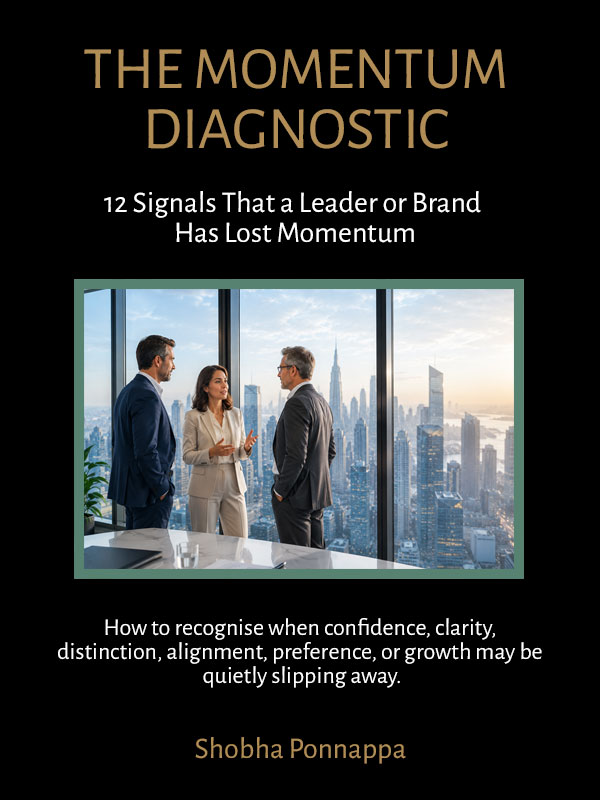
Download The Momentum Diagnostic and receive weekly insights on leadership clarity, brand distinction, and direction.
Get my free Momentum Diagnostic. Discover 12 signals that may be weakening leadership or brand performance.
You’ll also get my weekly Breakthrough Thinking newsletter, where I examine real situations across leadership and brands, and defining shifts.
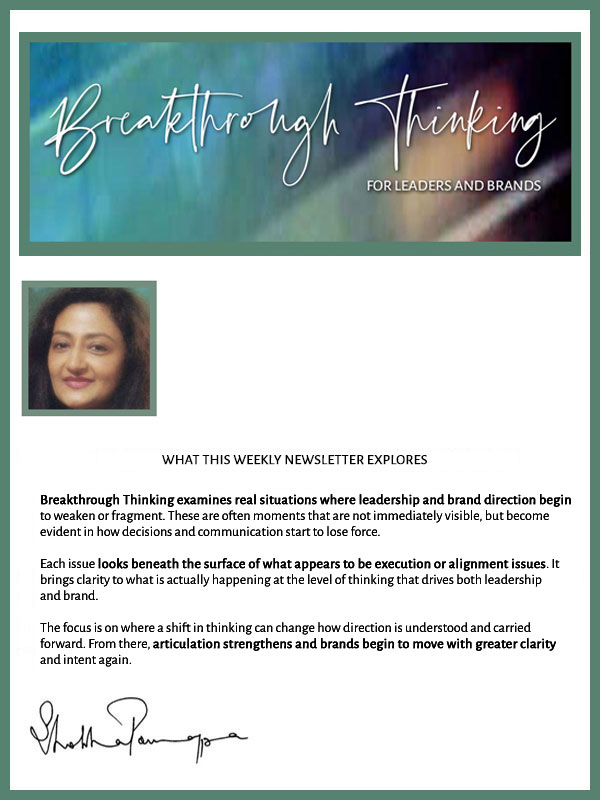
Just fill in the form to subscribe. Stay connected to how this thinking continues to evolve and unfold over time and across situations.