
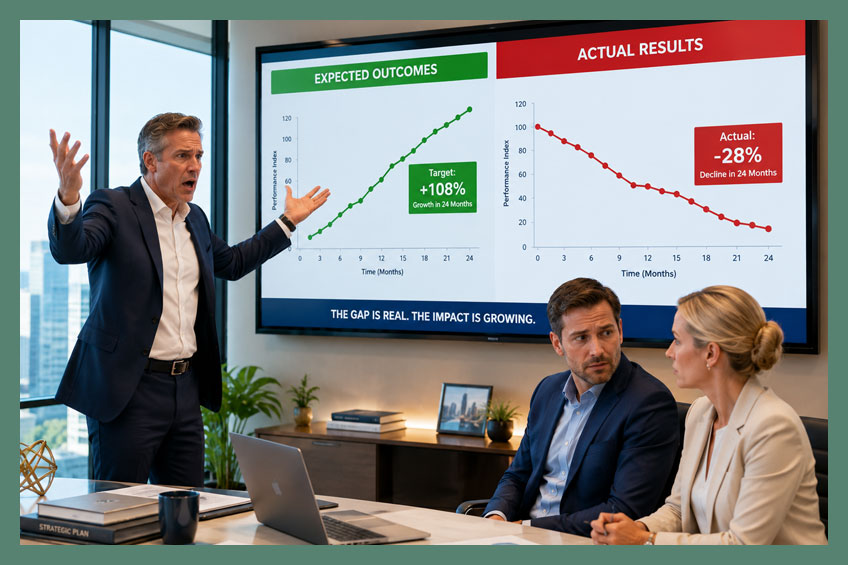
Many leadership teams take comfort in rapid alignment around strategic priorities. Meetings conclude with apparent agreement, stakeholders express support, and few visible objections emerge during discussions. The atmosphere feels constructive because consensus appears to have been achieved. The strategy often feels stronger than its execution eventually proves to be.
This situation frequently creates confusion because organisations interpret agreement as evidence of future momentum. Leaders leave the room believing that commitment has been established and progress will naturally follow. Months later, however, initiatives remain stalled despite continued support from the same stakeholders. The visible success of alignment may conceal the absence of accountability.
Many executives assume that once people agree with a strategy, execution becomes largely a management exercise. If stakeholders support the direction, resources are available, and priorities are clear, progress should logically occur. Yet implementation often unfolds very differently. Agreement and accountability operate according to different rules.
Consensus can create a powerful sense of collective commitment without establishing individual responsibility. Everyone may support the outcome while assuming somebody else will drive it forward. As a result, activity begins but momentum remains inconsistent. Support is often shared more easily than ownership.
Alignment is highly visible inside organisations. People attend workshops, contribute ideas, and participate in discussions that generate a strong feeling of collective engagement. These activities create confidence because they demonstrate involvement and cooperation. Participation can sometimes be mistaken for execution.
The difficulty is that consensus tends to measure agreement rather than delivery. Leaders leave the room feeling progress has been made because decisions have been reached and objections have been resolved. Yet no meaningful result has been produced at that stage. Decision-making and execution are not the same event.
Several patterns tend to appear when this issue begins developing. Strategic initiatives are frequently discussed, yet ownership remains vague whenever delivery is reviewed. Conversations focus on collective responsibility rather than named accountability. Responsibility becomes widely distributed and therefore weakly held.
Another signal emerges when progress updates concentrate on activity rather than outcomes. Teams describe meetings held, discussions completed, and plans created while measurable results remain limited. Effort remains visible while impact remains uncertain. Execution often slows when accountability becomes invisible.
Consensus is generally viewed as a positive leadership outcome. It reduces conflict, strengthens relationships, and creates a sense of organisational cohesion around important decisions. Most leaders therefore invest significant effort in achieving alignment before moving forward. The pursuit of agreement often receives more attention than the assignment of ownership.
There is also a natural tendency to avoid creating discomfort after achieving hard-won consensus. Explicit accountability introduces consequences, expectations, and scrutiny that may feel less collaborative than broad agreement. As a result, ownership is sometimes left deliberately ambiguous. Harmony can occasionally become an obstacle to execution.
The breakthrough often begins when organisations start distinguishing between support and responsibility. Instead of asking whether people agree with the strategy, leaders begin asking who is accountable for each outcome. This shifts the discussion from endorsement to delivery. Execution accelerates when ownership becomes unmistakable.
Once accountability is clearly assigned, strategic conversations become more focused and productive. Progress can be measured against defined responsibilities rather than collective intentions. Obstacles become easier to address because ownership no longer moves around the organisation. Momentum often returns when accountability acquires a name.
If your organisation appears highly aligned but continues struggling to convert plans into results, the issue may not be strategic quality. It may be that consensus has gradually replaced accountability as the primary measure of progress. In situations like this, additional meetings often reinforce the existing pattern rather than changing it. The breakthrough usually begins by examining ownership rather than agreement.
I take up work for leaders and brands through a focused 5-Day Assignment designed to create movement quickly and precisely. The process begins with a private strategy call, continues through five days of independent analysis, and concludes with a second private strategy call focused on what needs to change. The objective is not to add more activity, but to uncover what may be preventing progress from occurring. The assignment is designed for situations that appear aligned, but remain stuck.

“I take up work for leaders and brands through a 5-Day Assignment designed to create movement quickly and precisely. How I work is outlined here.”
Shobha Ponnappa
Download The Momentum Diagnostic and receive weekly insights on leadership clarity, brand distinction, and direction.
Get my free Momentum Diagnostic. Discover 12 signals that may be weakening leadership or brand performance.
You’ll also get my weekly Breakthrough Thinking newsletter, where I examine real situations across leadership and brands, and defining shifts.
Just fill in the form to subscribe. Stay connected to how this thinking continues to evolve and unfold over time and across situations.