


Markets rarely stand still, yet many organisations continue making strategic decisions using assumptions that were formed under very different conditions. Leadership teams often rely on customer expectations, competitive dynamics, or industry models that once produced reliable results without questioning whether those foundations have shifted. The business keeps optimising for a reality that has already begun to disappear. Yesterday’s assumptions rarely produce tomorrow’s advantage.
This often explains why capable organisations suddenly struggle to interpret unexpected market behaviour. Customers begin valuing different outcomes, competitors emerge from unexpected directions, and entirely new forms of value creation quietly reshape the landscape. The external world changes while internal decision-making remains anchored to familiar patterns. The market moves first … organisations often realise it much later.
In many situations like this, success itself becomes the strongest source of strategic inertia. Past achievements reinforce existing frameworks, making leaders understandably reluctant to question the very assumptions that previously created growth. Experience becomes trusted evidence even when the surrounding environment has fundamentally changed. Yesterday’s victories can quietly become today’s constraints.
Sometimes the issue is not resistance to change but the invisible persistence of inherited thinking. Strategic plans, reporting structures, performance measures, and customer narratives continue reinforcing the same worldview year after year because they still appear logical internally. Few people pause to ask whether those assumptions still match external reality. Organisations often preserve assumptions long after markets have abandoned them.
You may notice it when the business continues executing efficiently yet struggles to generate the commercial outcomes it once achieved. Marketing campaigns perform adequately, operational improvements continue, and leadership remains disciplined, yet momentum gradually begins slowing without any obvious explanation. Teams work harder while results become increasingly unpredictable. Execution cannot compensate for outdated assumptions.
Sometimes the signs appear through recurring strategic surprises. Competitors succeed with approaches that previously seemed unrealistic, customer priorities shift unexpectedly, or innovations that initially looked insignificant begin changing purchasing behaviour across the category. Internal forecasts become steadily less reliable despite careful planning. The future rarely conforms to yesterday’s strategic map.
When organisations continue organising themselves around outdated assumptions, they often misdiagnose the resulting problems. Leadership may invest in better technology, larger marketing budgets, operational efficiencies, or structural changes without addressing the underlying strategic model guiding those decisions. Resources become increasingly effective at solving the wrong problem. A flawed assumption multiplies the cost of every decision built upon it.
Over time, the business begins experiencing a widening gap between effort and impact. Teams remain committed, talented, and hardworking, yet the organisation gradually loses relevance because it continues interpreting the market through an increasingly outdated lens. Competitors who recognise emerging patterns earlier begin creating disproportionate advantage. Strategic timing often matters more than strategic effort.
This is often where I work … not by immediately proposing new strategies, but by examining the assumptions underneath existing ones. The breakthrough frequently comes from identifying which beliefs about customers, competition, growth, or value creation no longer accurately reflect today’s environment. Once those hidden assumptions become visible, entirely different strategic possibilities often emerge. The strongest strategy usually begins by questioning what everyone else accepts.
In my work, I often look beneath visible business challenges to understand the thinking that continues producing them. Many organisations possess capable leadership, talented people, and sound execution, yet remain constrained by assumptions that quietly shape every important decision. Reframing those assumptions often creates greater leverage than simply improving execution. Changing the underlying logic changes everything built upon it.
If this feels familiar, I take this up through a focused 5-Day Assignment … one 40-minute private strategy call to understand the situation, five days of independent work, and a second 40-minute private strategy call to take you through what needs to change.
Request a 5-Day Assignment here: https://shobhaponnappa.com/how-to-work-with-me/
The page outlines how I work, the assignment structure, fee range, and how to submit a brief note on your situation for review. If the fit and timing are right, I will come back to you directly. Not every situation needs this … but the right ones often benefit from a breakthrough early.
SHOBHA PONNAPPA
Breakthrough Strategist for Leaders and Brands in High-Stakes Moments
“One distinctive idea moves a brand. One defining voice moves a market.”

“I take up work for leaders and brands through a 5-Day Assignment designed to create movement quickly and precisely. How I work is outlined here.”
Shobha Ponnappa
Download The Momentum Diagnostic and receive weekly insights on leadership clarity, brand distinction, and direction.
Get my free Momentum Diagnostic. Discover 12 signals that may be weakening leadership or brand performance.
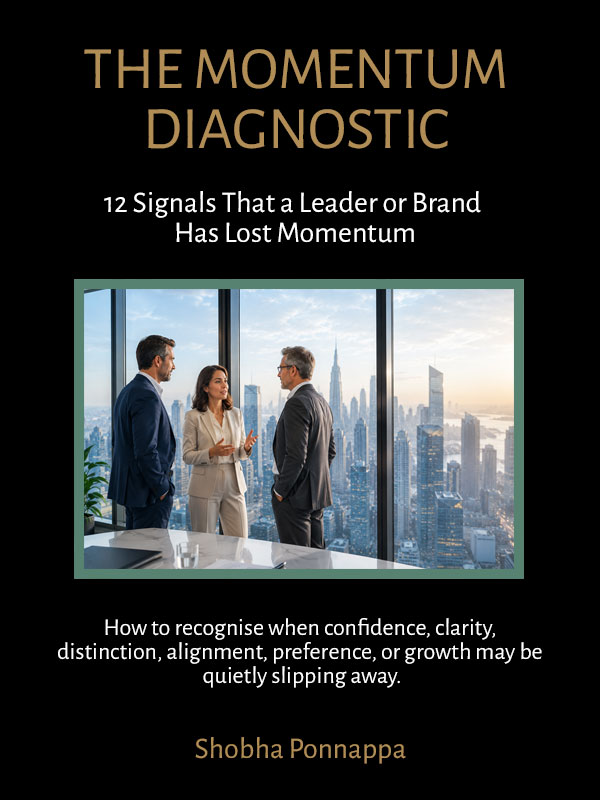
You’ll also get my weekly Breakthrough Thinking newsletter, where I examine real situations across leadership and brands, and defining shifts.
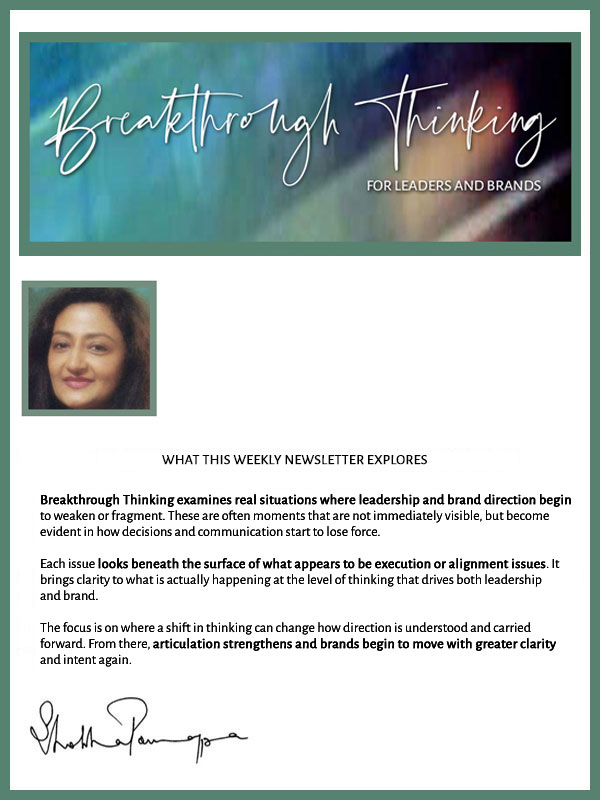
Just fill in the form to subscribe. Stay connected to how this thinking continues to evolve and unfold over time and across situations.