

Many leadership teams invest significant effort transforming products, capabilities, operating models, and growth strategies. New markets are entered, customer propositions evolve, and commercial performance begins to reflect meaningful progress. Yet external perceptions often appear strangely resistant to change. The business may have moved forward while market assumptions remain behind.
This disconnect creates confusion because executives naturally expect valuation to respond to evidence of change. The organisation sees new capabilities, new momentum, and new opportunities becoming visible across the business. Investors, analysts, or acquirers may continue evaluating the company through an older lens. Valuation frequently reflects interpretation rather than transformation itself.
Most organisations assume that transformation automatically updates external perceptions. Once a strategic shift begins producing visible results, leadership often expects valuation to follow naturally. In reality, markets rarely reassess assumptions as quickly as management teams hope. Perceptions often lag behind operational reality.
Investors build mental models that help them understand a business over time. These models are shaped by historical performance, industry narratives, and long-established expectations. Even substantial change may initially be viewed as temporary rather than structural. The market often values what it believes will persist rather than what has recently appeared.
Historical narratives possess remarkable staying power in financial markets. A company that spent years being viewed as mature, cyclical, or constrained may continue carrying those labels long after circumstances begin changing. New evidence frequently competes with deeply established beliefs. Yesterday’s narrative often remains embedded within today’s valuation.
The challenge is not necessarily scepticism. Investors are continuously exposed to promises of transformation that fail to deliver lasting results. As a result, many prefer to wait for repeated confirmation before adjusting assumptions. Markets often reward consistency before they reward possibility.
Strong performance can improve financial outcomes without changing the framework through which those outcomes are interpreted. Revenue growth may increase, margins may strengthen, and strategic execution may improve considerably. Yet the market may continue applying the same assumptions it used previously. Performance improvements do not automatically trigger narrative reclassification.
Valuation multiples are often influenced by expectations of future behaviour rather than current achievement. If investors believe recent improvements are temporary, they may hesitate to adjust long-term assumptions. The business may therefore receive credit for results without receiving credit for strategic repositioning. The market distinguishes between performance and permanence.
In many situations, investors are seeking evidence that change has become embedded rather than experimental. They want to understand whether new capabilities, revenue streams, or strategic advantages can be sustained through different market conditions. Confidence grows when change appears repeatable rather than exceptional. Durability often matters more than novelty.
This explains why leadership teams sometimes feel trapped in a frustrating cycle. Every milestone achieved appears to generate demands for additional proof. What seems excessive from inside the business may simply reflect the market’s process for reducing uncertainty. Valuation often follows confidence rather than progress alone.
The turning point often occurs when evidence accumulates to a level that makes the old narrative difficult to defend. At that stage, investors begin reassessing not only performance, but the underlying identity of the business itself. The conversation changes from what the company was to what it may have become. Narrative revision frequently precedes valuation revision.
Once market participants adopt a different interpretation, valuation dynamics can change rapidly. Information that was previously ignored may suddenly become highly relevant. The same business can begin attracting a different level of attention, confidence, and strategic interest. Valuation often changes when meaning changes.
Many organisations assume their challenge is operational when the real issue is interpretive. They continue investing in execution while overlooking the assumptions shaping external perceptions. As a result, performance improves while valuation remains stubbornly unchanged. The visible problem may be financial while the underlying issue is narrative.
I frequently see situations where businesses have evolved faster than the market’s understanding of them. The gap between reality and perception can persist for surprisingly long periods before suddenly closing. Understanding why that gap exists is often more important than generating additional activity. The breakthrough usually begins when hidden assumptions become visible.

“I take up work for leaders and brands through a 5-Day Assignment designed to create movement quickly and precisely. How I work is outlined here.”
Shobha Ponnappa
Download The Momentum Diagnostic and receive weekly insights on leadership clarity, brand distinction, and direction.
Get my free Momentum Diagnostic. Discover 12 signals that may be weakening leadership or brand performance.
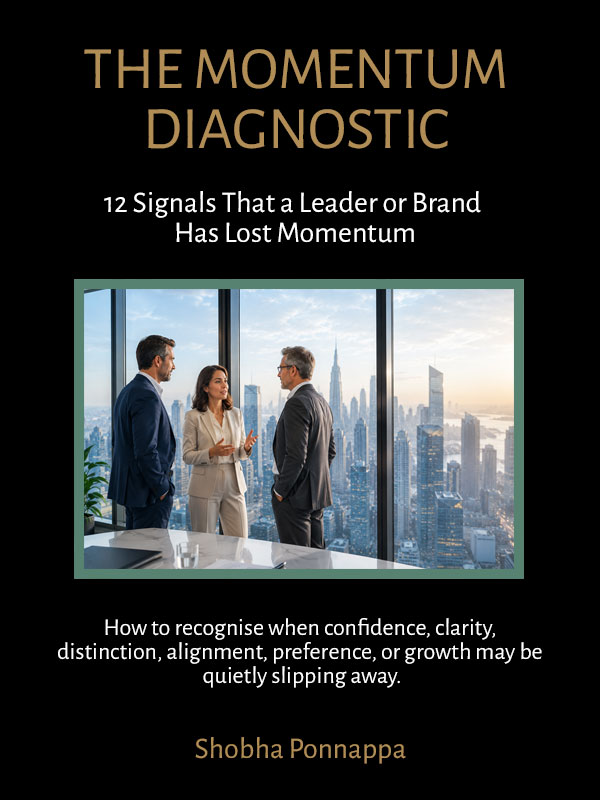
You’ll also get my weekly Breakthrough Thinking newsletter, where I examine real situations across leadership and brands, and defining shifts.

Just fill in the form to subscribe. Stay connected to how this thinking continues to evolve and unfold over time and across situations.