

There are situations where CEOs define a clear strategic intent at the outset, yet find that it begins to take on a different meaning as it moves through the organisation. This typically shows up as aligned activity that nonetheless feels directionally inconsistent, with teams interpreting the same intent in materially different ways. The issue is rarely the quality of the original strategy, but whether its meaning has been held consistently as it travels from boardroom to execution. This case study examines how strategic intent can shift course mid-journey, and what needs to change for its meaning to remain intact.
I examine how a CEO’s strategic intent took the wrong road as it travelled across the organisation … see how I reframed its articulation.
The CEO had articulated a strategic intent that was clear, well-reasoned, and strongly anchored in market reality. The board had aligned around it, and the leadership team had accepted it as the guiding direction for the business. Early execution indicated momentum, with multiple functions moving in apparent coordination. The strategy entered the organisation with clarity and initial alignment.
Over time, however, the expression of that intent began to diverge across teams and decision points. Different leaders interpreted priorities in ways that were individually logical, yet collectively inconsistent. The CEO found that outcomes no longer reflected the precise direction originally set. Strategic intent was moving forward, but not in the same form in which it was defined.
What I observed was not confusion or resistance, but a gradual reinterpretation of meaning as intent travelled through layers of leadership. The CEO’s original judgement had been expressed clearly at the point of articulation. However, it had not been stabilised in a way that could hold its meaning across varying contexts and decisions. Intent had been stated, but not anchored against reinterpretation.
In complex organisations, strategic intent is not transmitted once and retained unchanged. It is continuously interpreted at each level where decisions are made. When articulation does not fix the boundaries of meaning, intent adapts to local logic rather than holding central coherence. The shift was not in strategy itself, but in how its meaning was being carried.
I reframed the issue away from reinforcing alignment or increasing communication frequency. The work was not about repeating the strategy more often or clarifying it in greater detail. It was about stabilising how the CEO’s intent was articulated so that its meaning could withstand reinterpretation across contexts. The CEO needed to define what the intent meant, and what it could not become.
Working closely with the CEO, I helped reshape the articulation of strategic intent to include its boundaries and invariants. We ensured that interpretation could flex within defined limits without altering core meaning. Language was refined to carry both direction and constraint simultaneously. Intent became something that could travel without changing form.
At C-suite level, strategy is not evaluated only by its clarity at inception, but by its fidelity through execution. Boards and stakeholders expect that intent will hold its meaning as it translates into action. When that meaning shifts, even strong execution can appear misaligned with original direction. Authority depends on whether intent remains recognisable as it unfolds.
For this CEO, the risk was not strategic failure, but gradual divergence masked by ongoing activity. Without a stable articulation of intent, the organisation could continue to move while drifting away from its intended path. This created a disconnect between what was set at the top and what was realised in execution. The breakdown lay in the travel of intent, not in its formulation.
Here are ten directions that changed the nuances of articulation:
CONFIDENTIALITY CAVEAT: This essay reflects an anonymised leadership situation drawn from long-term exposure to senior decision-making environments. Specific individuals, organisations, and timelines have been intentionally withheld to preserve discretion.

“I take up work for leaders and brands through a 5-Day Assignment designed to create movement quickly and precisely. How I work is outlined here.”
Shobha Ponnappa
Download The Momentum Diagnostic and receive weekly insights on leadership clarity, brand distinction, and direction.
Get my free Momentum Diagnostic. Discover 12 signals that may be weakening leadership or brand performance.
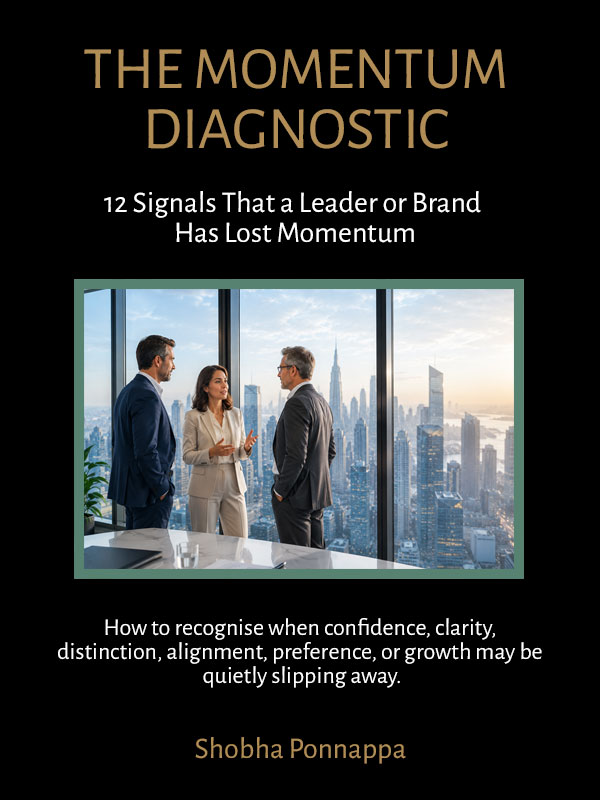
You’ll also get my weekly Breakthrough Thinking newsletter, where I examine real situations across leadership and brands, and defining shifts.
Just fill in the form to subscribe. Stay connected to how this thinking continues to evolve and unfold over time and across situations.